What Are Robot Skills And How Agentic AI Changes Industrial Robot Programming
September 10, 2026
,

For decades, industrial robot programming has often involved defining movements and logic for a specific task, then updating the program when a change falls outside its existing configuration. Agentic AI is starting to change that relationship, not by removing the engineering behind a robot cell, but by changing how an operator describes what needs to happen and how that description becomes a validated set of robot actions.
This shift involves Agentic AI and the robot skills that provide its reusable execution capabilities. Understanding them separately is useful, since they solve different parts of the same problem.
What Is Agentic AI in Robotics?
An AI agent, in the context of industrial robotics, is a system that can interpret an instruction, decide which actions are needed to carry it out, and monitor whether those actions actually succeeded. In our AI-powered robot application software platform, Acteris, this is the layer an operator actually talks to. That goes beyond a simple command interface, which maps an instruction to a predefined action.
It's worth being precise about what this does and doesn't mean. A conversational interface is not the same thing as autonomous engineering. An operator describing a task in natural language is not writing code, but the system still has to configure the cell, check the request against real constraints like reach and collision risk, and validate the plan before anything moves. Agentic AI changes how that configuration happens, not whether it happens.
What Is a Robot Skill?
A robot skill, the building block Acteris uses to execute a task, is a pre-built, tested capability, such as picking a part, loading a machine, or inspecting a placement, that has already been validated and packaged so it can be selected and configured rather than programmed from scratch for every new task. A skill isn't a single hardcoded motion. It's a parameterized capability: the underlying behavior stays the same, while inputs like part dimensions, grip position, or target location change based on the specific job.
This distinction matters because it's the difference between building something new every time and reusing something that already works.
How Are Robot Skills Different From Traditional Robot Programs?
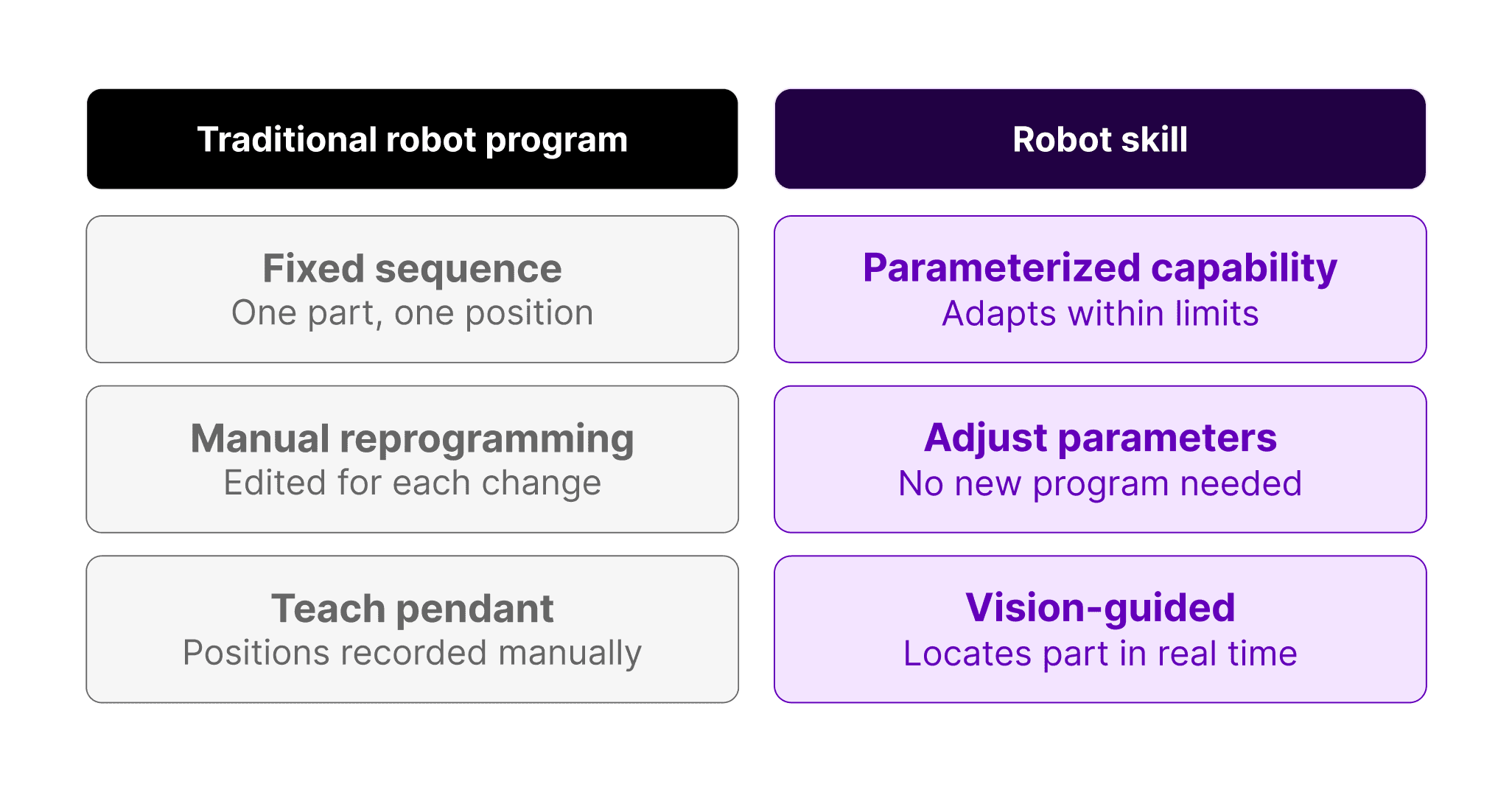
A traditional robot program is often developed for a defined part or part family, position range and machine setup. If a change falls outside the program’s existing logic or configured range, an engineer may need to edit it directly, often using a teach pendant to record new positions.
A robot skill is built to handle a range of conditions within defined limits. Instead of one exact position, a pick skill might work across a range of part positions and orientations, using vision to locate the part rather than relying on it arriving in exactly the same place every time. Changing the job usually means adjusting parameters, part dimensions, target location, batch size, not rewriting the underlying program.
How Do AI Agents Turn Manufacturing Instructions Into Robot Actions?
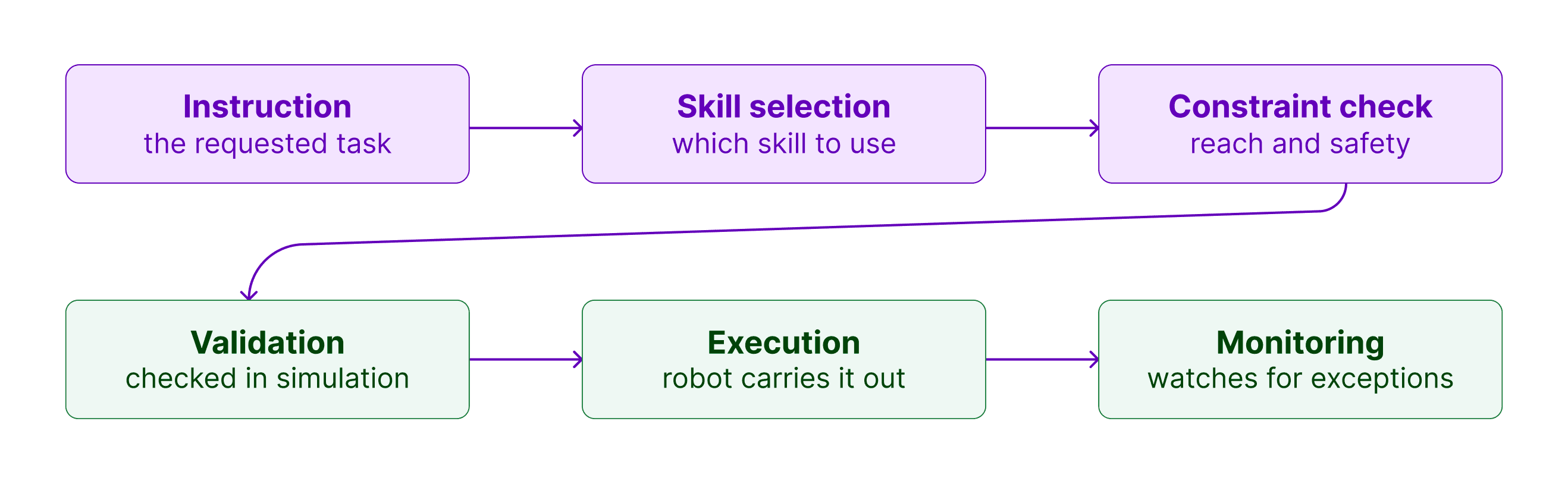
When an operator describes a task, an AI agent moves through several distinct stages that connect the instruction to physical execution.
Interpreting the Operator's Task
The agent first identifies what the operator is actually asking the robot to do. This step matters more than it might seem: an ambiguous or incomplete instruction, if misread, can result in a plan that technically executes on the robot but doesn't do what was actually needed. A well-built system asks a clarifying question rather than guessing.
Selecting and Sequencing Robot Skills
Once the task is understood, the agent selects the relevant skill or combination of skills needed to complete it, and determines the order they need to run in. A task like loading a machine and inspecting the result might require two distinct skills used in sequence, not one.
Checking Constraints Before Execution
Before anything moves, the plan is checked against relevant physical and system constraints, including reach, configured collision limits and machine interface requirements. This step is what separates a system that plans responsibly from one that discovers problems mid-execution.
Monitoring Results and Handling Exceptions
Execution isn't the final step. The agent continues monitoring throughout the run so it can respond if something unexpected happens, such as a part that didn't pick cleanly, or a machine that didn't reach its ready state, rather than continuing blindly or stopping without explanation.
Which Robot Skills Can Be Reused in Manufacturing?
Some categories of robot skills show up across a wide range of manufacturing tasks, which is part of why building them as reusable capabilities, rather than one-off programs, has real value.
Locating and Picking a Part
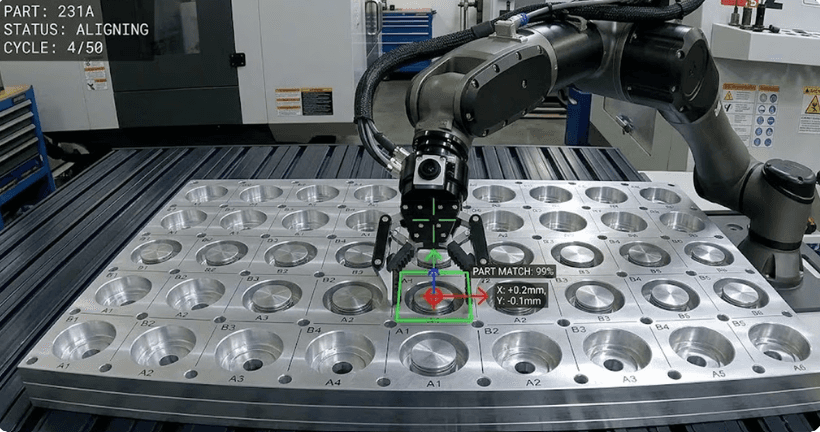
A vision-guided pick skill locates a part within a defined working area and computes a pick position, rather than requiring the part to arrive in an exact, pre-programmed spot. This is particularly useful in environments where parts vary in position or orientation between cycles.
Loading and Unloading a Machine
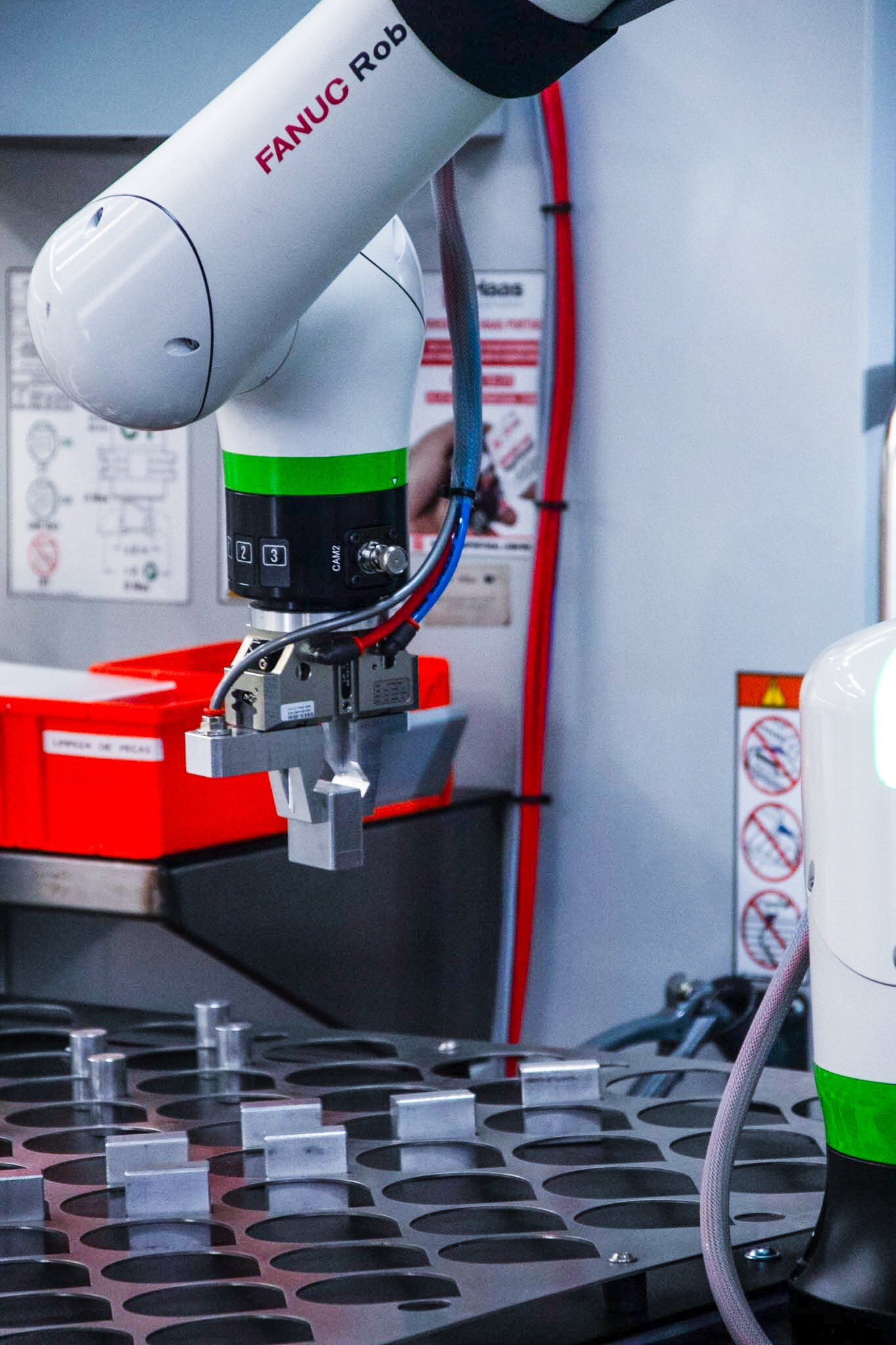
This skill covers presenting a part to a machine fixture or vise, coordinating with machine door and clamp signals, and removing the finished part once a cycle completes. Because this skill depends on machine communication as much as robot motion, it typically needs to be configured for the specific machine interface involved.
Aligning, Placing and Inspecting a Part
Some tasks require more than picking and moving a part; they require confirming it's correctly oriented, placing it with precision, or checking it against dimensional or surface requirements before the next step proceeds. These skills often combine vision-based verification with the physical placement action itself.
Pausing, Recovering and Resuming a Task
Not every skill involves motion. Recovery behavior, what happens when a part doesn't pick cleanly, an infeed runs empty, or a machine raises an alarm, can also be built as a reusable capability. Rather than stopping the cell entirely and waiting for an operator, a well-built recovery skill can either resolve the issue automatically within defined parameters or clearly communicate what it needs from an operator to continue.
How Do Reusable Robot Skills Support High-Mix Production?
High-mix production, where shops run many different part types with frequent changeovers, is where reusable skills tend to matter most. In a traditional setup, a new part type that falls outside the existing program’s configured range may require programming changes, new teach points and specialist time to configure. That changeover cost is a major reason automation has historically been harder to justify for high-mix environments than for high-volume ones running the same part for months.
When skills are reusable and parameterized, a new part often means adjusting existing parameters rather than writing a new program. This doesn't eliminate changeover work entirely, but it can meaningfully reduce how much of that work depends on specialist programming time.
Does Agentic AI Remove the Need for Robot Programming?
No, and it's worth being direct about that. Agentic AI changes how a task gets configured, but it doesn't remove the underlying engineering work: cell setup, safety configuration, integration with a specific machine's interface, and validation that a plan is achievable within the robot's real constraints. Robot skills still need to be built, tested, and maintained by people with the relevant expertise before they're available for an operator to use through natural language.
What changes is who's involved in day-to-day configuration. Once a skill exists and has been validated, an operator can parameterize and deploy it without needing to write or edit robot code themselves. The engineering that made that skill reliable is completed earlier and reused across subsequent jobs.
How Are Agentic Robot Skills Tested and Controlled Safely?
Because an AI agent is making decisions about what actions to take, safety and control matter as much here as they do in traditional automation, arguably more, since the range of situations a skill might encounter is broader than a single fixed program.
A few things are commonly true of systems built to handle this responsibly. A formal risk assessment remains part of any deployment, regardless of how the task was configured. Skills can be tested in simulation before they are used on physical hardware, helping identify planned motions that fall outside achievable limits. Reach, configured collision limits and machine interface requirements should be checked before execution, while machine interlocks remain enforced by the cell’s control system. Execution stays within a deterministic control layer, the same kind of predictable, industrial-grade control a conventional cell already relies on, rather than the AI agent having unconstrained control over the robot. When a skill encounters a condition outside its defined parameters, it should trigger a validated response, such as pausing the task or requesting operator input.
What Should Manufacturers and Integrators Assess in an AI Robot Skills Platform?
If you're evaluating a platform that uses agentic AI and reusable robot skills, a few specific questions are worth asking directly, since a conversational interface alone doesn't reveal much about what's happening underneath.
How does the system handle an ambiguous or incomplete instruction? Does it ask clarifying questions, or does it make assumptions about what the robot should do that aren't visible to the operator?
When a task requires more than one skill, how does the system decide the order and combination of skills to use? Is that logic something an integrator can inspect, or is it fully opaque?
Does the platform validate a plan against real physical constraints before anything moves? What happens when a plan fails validation? Does it stop cleanly, or does diagnosis require manual intervention?
Once a task is running on the robot, how does the system detect that something has gone wrong, and what does it do next? A platform that can clearly communicate what happened and what it needs is meaningfully different from one that simply halts without context.
Asking these questions during evaluation is a more reliable way to understand what a platform actually does than watching a single successful demo.
Frequently Asked Questions
What is agentic AI in robotics?
Agentic AI refers to a system that can interpret an instruction, decide which actions are needed to carry it out, select and sequence the relevant capabilities, and monitor whether those robot actions succeeded. It differs from a simple command interface in that it works across multiple steps rather than translating one instruction into one fixed action.
What is a robot skill?
A robot skill is a reusable capability, such as picking a part or loading a machine, that can be selected and configured for a new task rather than programmed from scratch. Skills can be parameterized, meaning the same underlying behavior can adapt to different part dimensions, positions, or targets within defined limits.
Can agentic AI program an industrial robot without code?
An operator can configure and deploy existing robot skills through natural language without writing code themselves. That's different from creating skills without engineering involved. Building and validating a new skill still requires the underlying development and testing work.
How are AI robot skills tested for safe execution?
Skills can be tested in simulation before running on physical hardware, with reach and configured collision limits checked before execution. The resulting robot actions are then executed through the cell’s deterministic control layer. A formal risk assessment remains part of any deployment, and conditions outside a skill’s defined parameters should trigger a validated response, such as a pause or a request for operator input.