Meet the Treners: Dr. Alejandro Astudillo and the Future of Adaptive Motion
March 24, 2026
Trener Robotics
,

At Trener Robotics, the shift from "programmed" to "autonomous" is the defining challenge of modern industrial manufacturing. Leading this technical frontier is Dr. Alejandro Astudillo, a founding member of our team who has stepped into a new role as VP of R&D, and a Product Research Fellow.
Alejandro’s work sits at the intersection of high-fidelity vision systems and real-time control for safe, robust and optimized robot motions. With a Ph.D. in Mechanical Engineering from KU Leuven, his research in model predictive control and optimization now powers the Acteris software that enables robots to learn, adapt, and execute complex manipulation tasks.
From Natural Language to Real-World Execution
Alejandro’s research efforts are central to closing the gap between human intent and robotic action. The process begins with the Acteris AI agent, where a user defines a job using natural language. The system then manages the entire lifecycle:
Intelligent Configuration: The AI agent translates instructions into a structured workflow, moving instantly from job creation to digital simulation.
Vision-Guided Part Detection: In the physical cell, the AI vision system identifies parts in unstructured environments, accounting for shifting positions and variable lighting.
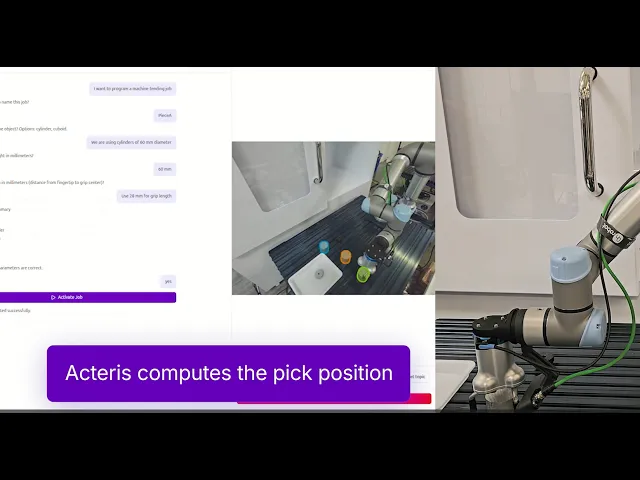
Autonomous Computation: Acteris computes the optimal pick position in real time, eliminating the need for rigid fixtures or precise part presentation.
Adaptive Motion Control: The robot does not follow a static path. It dynamically adjusts its trajectory and gripping to load and unload machines with automatic, adaptive motion control.
High-Fidelity Intelligence: The UR5e Demo
To see Alejandro’s research in practice, watch our latest technical demonstration. Using a Universal Robots UR5e, we showcase the transition from simulation to real-world execution. You can observe the robot adjusting its trajectory mid-motion, reacting to the environment, and executing complex tasks that previously required hours of custom code.
"We aren't just giving robots a set of eyes; we are giving them the ability to reason through physical constraints. By combining vision-guided detection with adaptive motion control, we are transforming the robot from a repetitive tool into an intelligent partner that understands the variability of the shop floor." — Dr. Alejandro Astudillo
The Mission
As VP of R&D, and a Product Research Fellow, Alejandro ensures our skill-based automation remains industrially reliable. By focusing on adaptive motion and part detection, he is helping Trener build a world where automation is no longer a static asset, but an evolving solution that compounds in value over time.