Physical AI Is Being Defined Right Now. Here Is Where Trener Stands
September 16, 2026
Dr. Asad Tirmizi
,
Founder & CEO

This year has been the one where Trener started to look like the company we set out to build. Deployments picked up, new partners came on board, and the product is changing how our customers work day to day.
Deployments Across Four Countries
Recently, Trener completed 4 deployments across 4 countries, spanning both the US and Europe. We now work with 9 system integrators across our ecosystem.
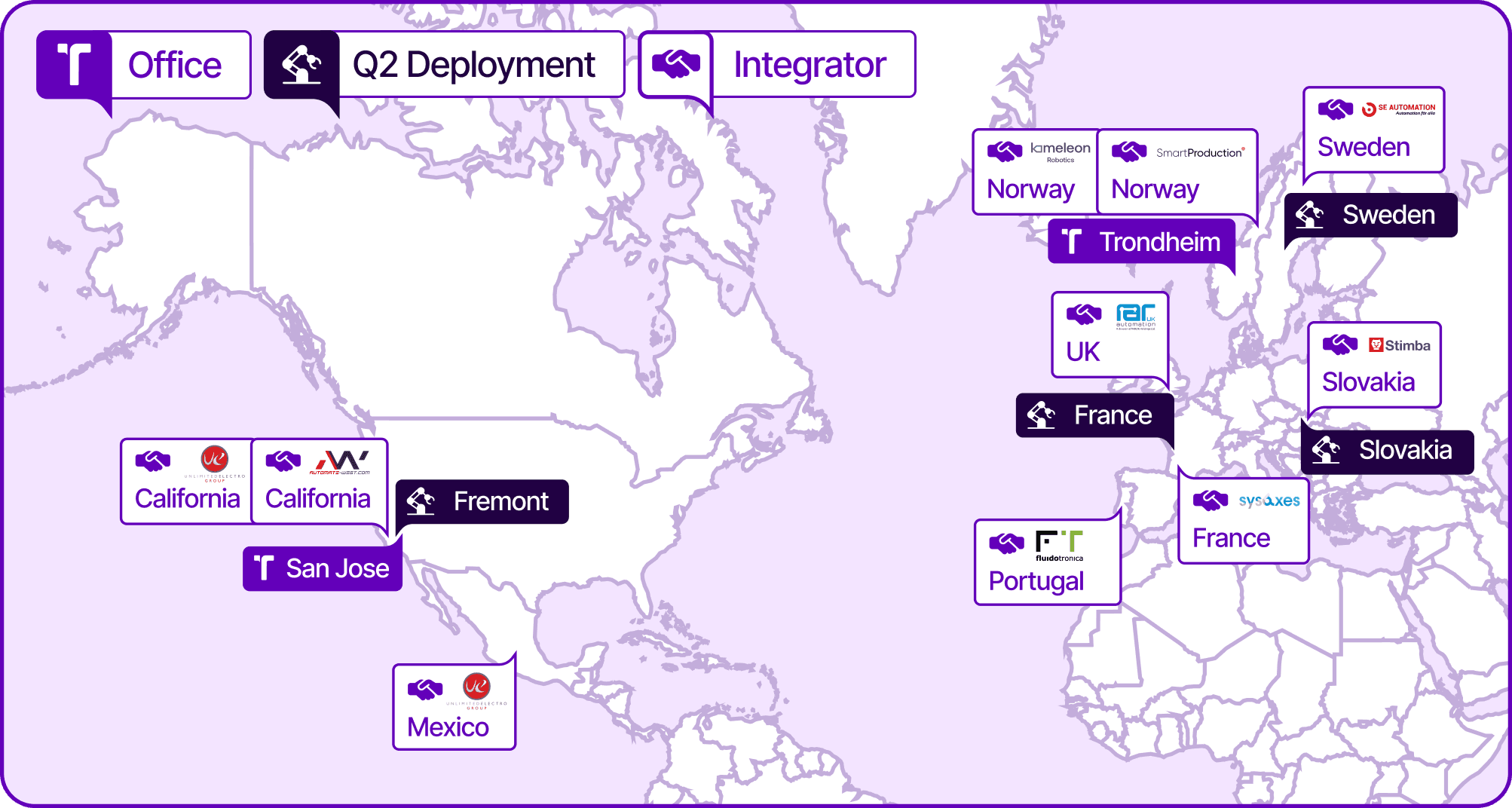
Each new deployment teaches us something new about what manufacturers actually need on the floor, which in turn shapes what we build next.
Acteris v0.8: Built From Real Shop Floor Feedback
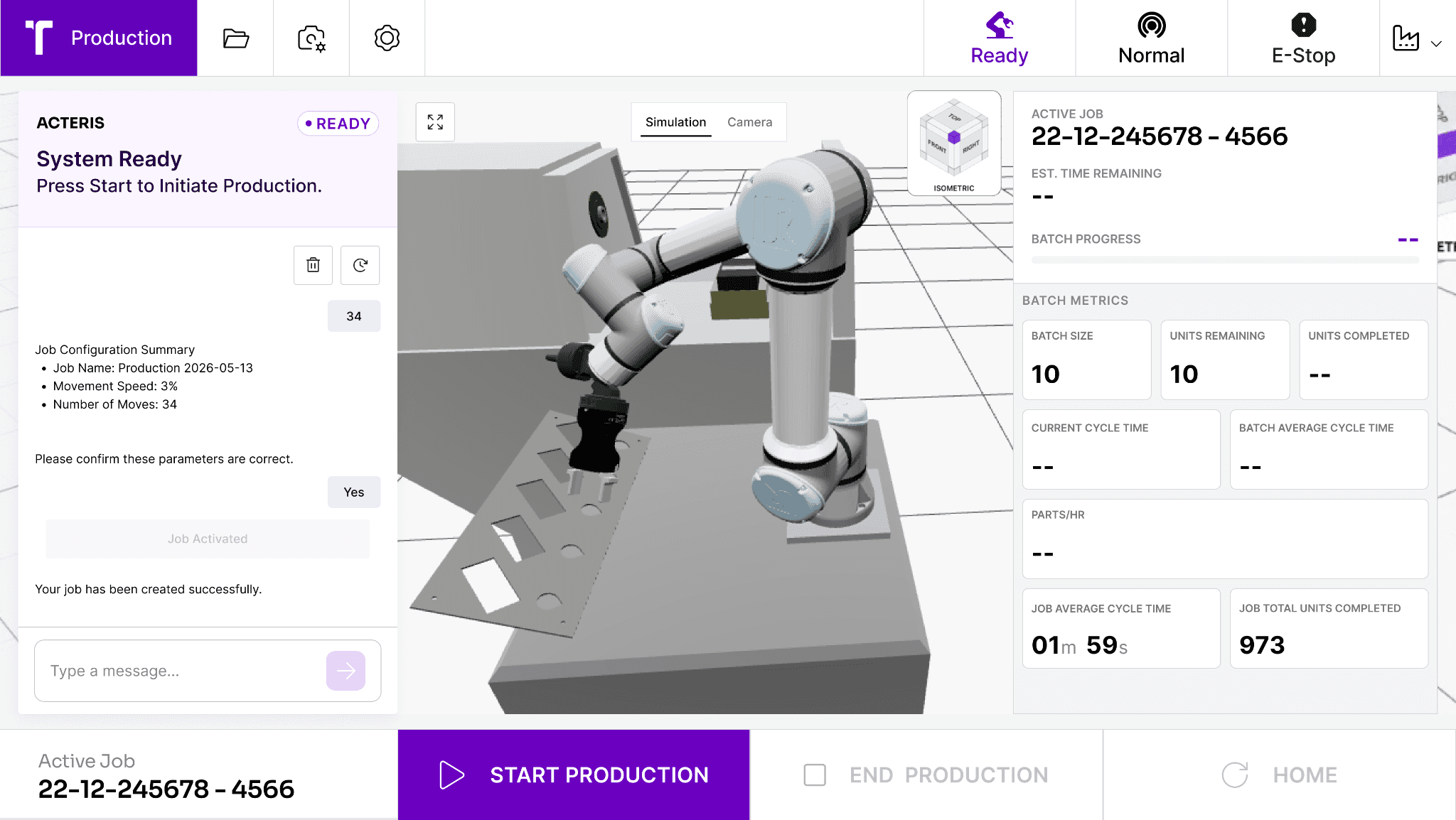
Acteris v0.8 is the most stable and production-ready release we have shipped, validated across multiple field deployments. It rebuilds the operator experience, expands production control for real shop floor situations, and brings the AI agent to the edge in six languages.
Acteris now supports a growing range of skills across the production floor, from machine tending to wipe-downs, force-based insertions, stacking, and sorting. One of the most meaningful improvements is how operators can now control what happens when production stops. Rather than a binary on and off, v0.8 gives operators real options: pause and resume from exactly where the job left off, end production cleanly at the close of the current cycle, or reset immediately with the robot returning home autonomously and safely handling any part currently in its gripper. These are the kinds of controls that matter when something unexpected happens on a real production line.
The results are speaking for themselves.
Scaling Through Integration Partners
The Acteris Integration Suite is being extensively tested internally. It will let Trener provide support to system integrators deploying Acteris independently, at scale, without needing Trener engineers on-site for every project.
This matters as much for integrators as it does for us. There are more than 8,000 system integrators across traditional and emerging automation, and the Integration Suite is how they'll gain access to the latest AI robotics capabilities, for both established applications and areas the industry is only beginning to automate.
The Integration Suite 3D Scene Editor has been completed and released for internal use, with beta access coming soon.
New Capabilities From T-Labs
It has been a strong stretch for our research team, T-Labs. Workcells in both San Jose and Trondheim are now fully operational. We successfully demonstrated learned policies for machine tending, a significant milestone in our fast-expanding robot foundation model. The Trener Data Collection Kit is being further developed, accelerating our ability to capture real-world data, including tactile and haptic interactions, and turn it into deployable robot skills at scale. The T-Labs team continues to grow.
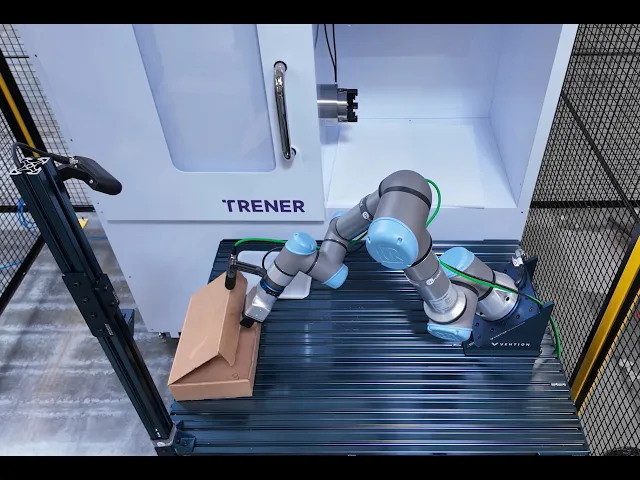
Most machine tending demos show a robot succeeding under ideal conditions. The video below shows something different: the same robot foundation model handling machine tending while we actively try to break it. Boxes get moved. Objects get shifted mid-task. The robot still finds the part, picks it, and adjusts on the fly, including opening a box it wasn't shown in advance and completing the task fully autonomously after being trained through teleoperation. This kind of robustness under real disruption hasn't been possible before, and it's the direction we intend to keep building on.
The video also shows three emerging Physical AI capabilities. Scene understanding, which lets the AI agent detect missing parts and request operator intervention through natural conversation. Real-time vision-based obstacle detection, which safely pauses execution and guides the operator to resume. And semantic reasoning, which lets the robot proactively identify and clear workspace issues, with operator approval.
Building Across Compute Platforms
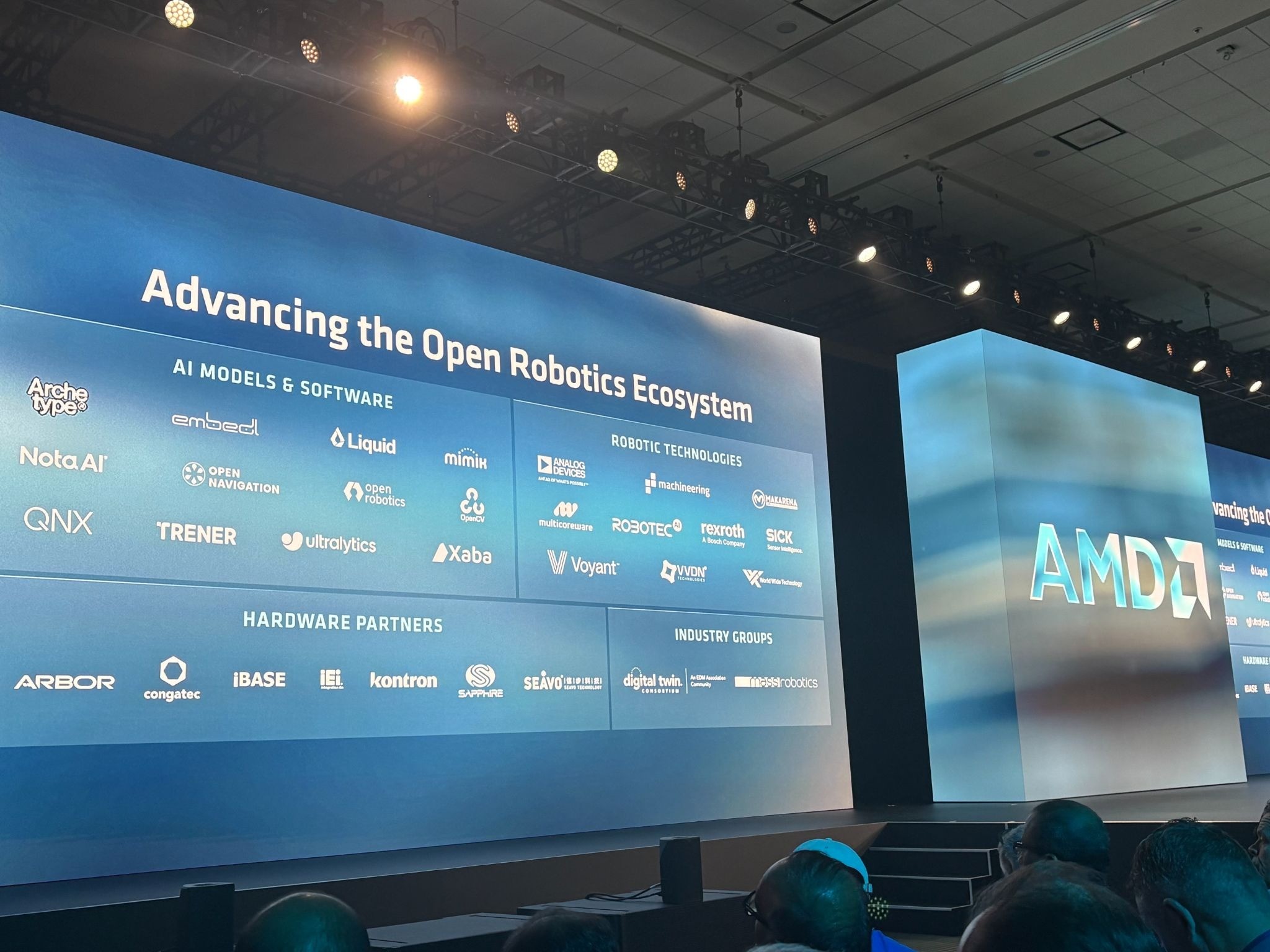
Trener is building relationships across the AI compute ecosystem, and this year has brought progress on multiple fronts. We were named a founding AI Models and Software partner in AMD's Open Robotics Ecosystem, announced by AMD CEO Lisa Su during the keynote at AMD's Advancing AI 2026 conference in San Francisco. Our AI models and robot skills now run on AMD's Kria compute platform. Read more about the partnership here.
We were also one of the first partners to join Arm Total Design for Physical AI, working on its new robotics capability framework. Alongside that, we're in active partnerships with Altera and Velaura. Together, these partnerships are enabling the next generation of silicon, allowing Physical AI to continue increasing in capabilities.
Our goal is to make Acteris and our AI robotics skills available across all major compute platforms, giving manufacturers and partners the flexibility to deploy on the infrastructure that best meets their needs.
Recognition From the Industry
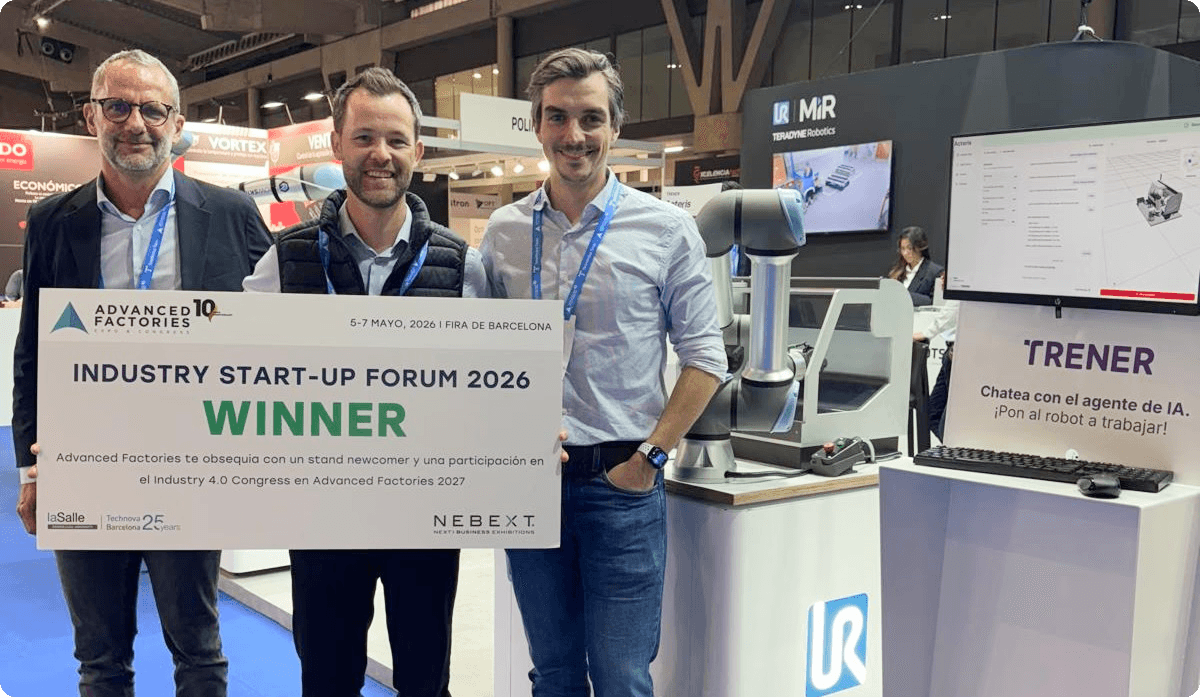
At Advanced Factories 2026 in Barcelona, Trener won the Industry Startup Forum 2026 Award, recognized among Europe's most disruptive startups transforming industrial automation. This adds to our list of recognitions alongside the 2025 CECIMO Machine Tools Innovation Award and the 2024 ABB Robotics AI Startup Challenge win.
At Automate 2026 in Chicago, we demonstrated Acteris at the Universal Robots booth, running a live CNC machine tending demo featuring AI-powered job setup, an autonomous machining cycle, and real-time optimal path planning. The interest from manufacturers and integrators confirmed what our deployment numbers are already showing: Physical AI is ready for production.
A Growing Team
Trener has grown to 40 people, with meaningful additions across T-Labs and the product team. We also defined our company values as a team, laying the organizational foundation to match the technical one. The caliber of talent we're attracting reflects both the ambition of what we're building and the momentum behind it.
Building the right organization isn't separate from building the product. At this stage, it's the same work.
What Comes Next
The work continues. The Integration Suite moves into beta access next, giving system integrators direct hands-on time with the platform. We're also deepening our work with chip makers and enterprise customers, building on the relationships already underway with AMD, Arm, Altera, and Velaura. And we'll keep growing where it counts: more deployments across the US and Europe, more integrators joining the ecosystem, and more people joining the team.
The foundation is solid, and the pace is accelerating.