Why Your Robot Stops Working the Moment Something Changes, and How to Fix It
May 6, 2026
Pablo Perez
,
Director of Product, Trener Robotics
If you have ever watched a robot cell grind to a halt because a part was slightly out of position, or waited days for a specialist to reprogram it for a new job, you already know the problem. Traditional automation is built for consistency. The real world is not.
This is the gap that is costing manufacturers thousands of hours in unrealized productivity every year. And it is the gap Acteris was built to close.
The Rigid Trap
Traditional industrial robots follow exact, hard-coded sequences. That works in high-volume, low-mix environments where nothing ever changes. But on a real shop floor, things change constantly. A part is slightly misaligned. Lighting conditions shift. Tolerances vary between batches. The moment any of these variables falls outside the programmed parameters, the robot stops, and production waits until a specialist shows up to fix it. For high-mix, low-volume manufacturers, this is not an edge case. It is a recurring cost that quietly erodes productivity and utilization.
Acteris gives robots the ability to see, sense, and adapt in real time. Using vision-language models, it identifies parts, determines their position and orientation, and adjusts the robot's motion accordingly. A part that is slightly out of place is not a problem. A change in lighting is not a problem. And critically, this adaptability does not come at the cost of reliability. Acteris maintains deterministic control throughout, keeping operations predictable, repeatable, and safe. You get the flexibility of Physical AI without sacrificing industrial-grade performance.
The Programming Burden
Every time you introduce a new part, switch jobs, or add a robot to your fleet, someone has to program it. That programming is typically vendor-specific, meaning code written for one robot brand does not transfer to another. If you run a mixed fleet, you are maintaining multiple codebases and depending on multiple specialists. Reprogramming a robot for a new part can take hours. In high-mix environments where jobs change daily, that lost time adds up fast. It is one of the leading causes of underutilization in CNC machine shops, and most of it is invisible because it happens before production even starts.
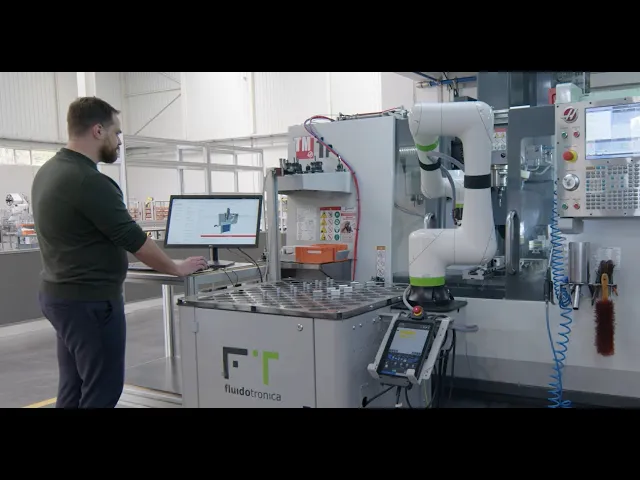
The video below shows what the alternative looks like. Our integration partner Fluidotronica deployed Acteris on a CNC machine tending cell in Portugal. From job creation to autonomous production, no programming required.
Acteris shifts control from specialized engineers to the people already on the shop floor. Operators interact with the Acteris AI agent using natural, conversational language. They describe the job and the system configures and runs the automation from there. New jobs are created in under 2 minutes. Recovery from production issues is handled through the same interface, without calling in a specialist. When any operator can launch a new batch, handle a changeover, or respond to a production issue without engineering support, your entire operation becomes more resilient. And because Acteris is hardware-agnostic, it works across ABB, Universal Robots, and FANUC today, with support for additional brands coming later in 2026.
The Business Result
The impact shows up quickly in production. A precision machining company in Norway had invested $125,000 in a robot that was sitting completely idle. Reprogramming for each new part was too complex and time-consuming, and operators had to stay at the machine for the full cycle time. Automation ROI was zero.
After deploying Acteris, new jobs were created in under 2 minutes, machines ran unattended between changeovers, and operators were freed to focus on higher-value work. That idle asset went from gathering dust to actively driving production.
This is what removing the programming burden and adding real-time adaptability actually looks like. Deployment is faster because Acteris provides a standardized software layer that shortens commissioning timelines for both new cells and retrofitted installations. Utilization goes up because machines run unattended and operators manage multiple cells instead of one. The capital you already invested in automation starts delivering the return you expected.
A New Standard for the Factory Floor
Traditional automation stalls because it was never designed for the variability of real production. Acteris is built to solve that. By combining Physical AI with an agentic AI layer that acts as a co-pilot for your operators, Acteris gives manufacturers automation that adapts to their production, not the other way around. The robot handles the physical work. The AI agent guides the operator through every step, from job creation to recovery, so your team always has the support they need to keep production moving.