From Code to Intelligence: Trener Robotics CEO Asad Tirmizi on the Future of Model-Driven Manufacturing
May 20, 2026
Trener Robotics
,

Trener Robotics CEO Asad Tirmizi recently sat down with Jeannie Cahalane of AI Press Room for an in-depth interview on why industrial automation is shifting from code-defined workflows to model-defined skills, and what that means for the future of the factory floor. You can read the full interview at AI Press Room.
Below are the key insights from that conversation.
Programming Hours Are No Longer the Constraint
Under the traditional model, an integrator's value was locked in the hours spent hard-coding a single part. In a model-defined world, that changes. As Asad explains, economic power shifts to the platform that can take a thousand messy edge cases from different shops and turn them into a reliable, out-of-the-box skill. The winner is whoever owns the intelligence that makes a robot perform better on day 100 than it did on day one.
What Simulation Gets Wrong
One of the most honest moments in the interview comes when Asad is asked what real-world variable most frequently breaks a model that worked in simulation. His answer: contact forces. Synthetic data generated through simulation or video does not accurately capture the physics of physical interaction. This pushed Trener to invest heavily in haptics capabilities and physics solvers, a foundational improvement that now sits at the core of how Acteris handles real production environments.
The Trade-Off Manufacturers Have to Accept
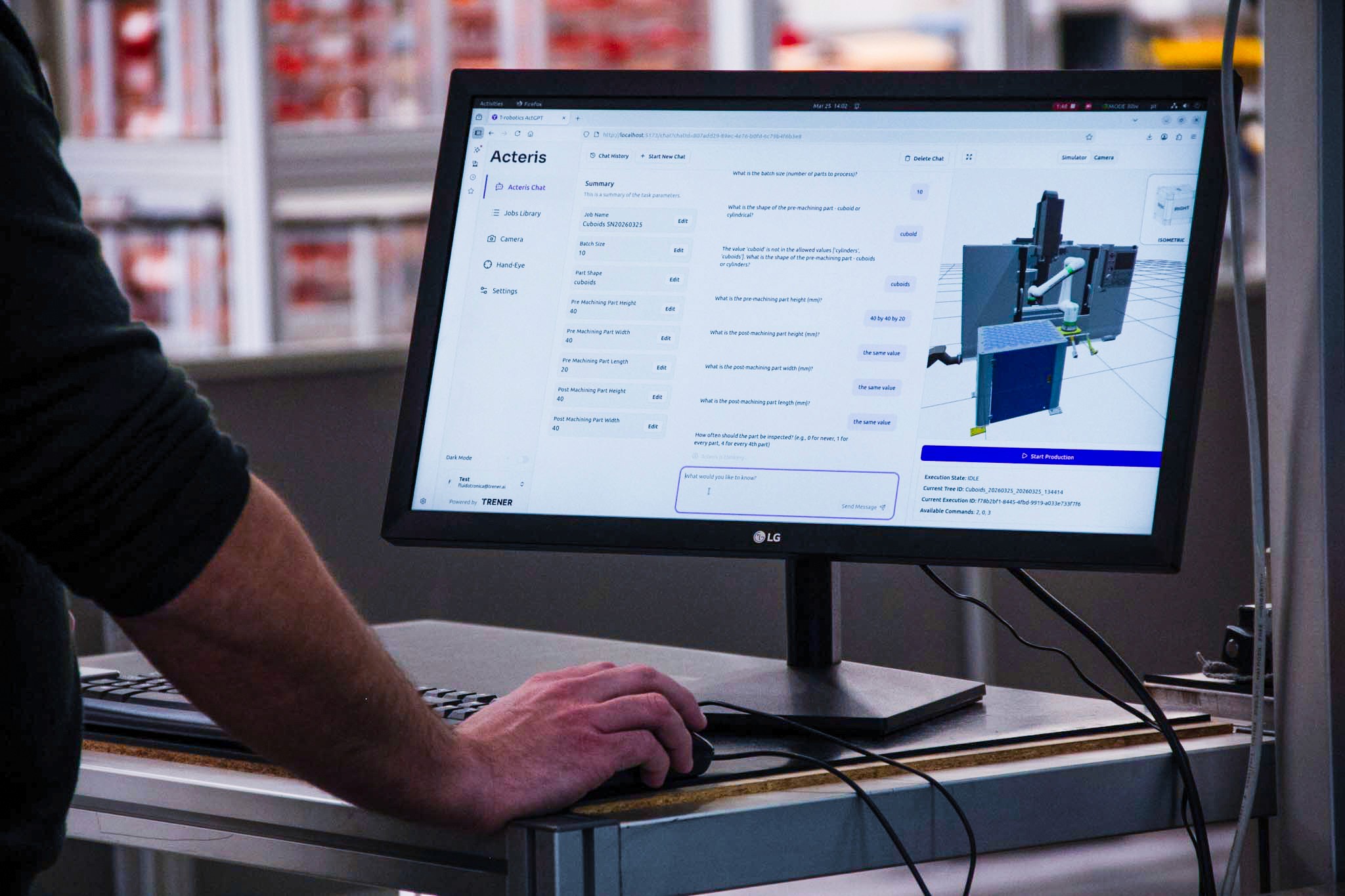
Replacing deterministic scripts with adaptive models means giving up the fixed path. A robot running Acteris might take a slightly different angle to grab a part because it sensed the part was tilted or there were chips in the way. As Asad puts it, plant managers have to trade the comfort of seeing the same repetitive motion for the certainty that the part actually gets loaded correctly, even when the environment is unstructured. For most manufacturers, that is a welcome trade-off.
Why Trener Started with CNC Machine Tending
Despite the broader applicability of Physical AI, Trener deliberately focused on CNC machine tending first. Asad accepted the risk of being misread as a niche player. The reasoning is straightforward: if a model can handle the tight tolerances and grit of a CNC cell, it has already mastered the hardest variables in the factory. Rather than spreading thin across easy wins, Trener chose to solve the hardest problem first. Everything else becomes a downstream application of that core intelligence, and the platform is built to expand from there.
The Moment That Changed Everything
When asked about the first production deployment that proved something non-obvious, Asad points to a chip blow-off step. The assumption was that the big win for AI would be the precision of the grip. It wasn't. The real value was the robot realizing that metal chips on the fixture would prevent the part from sitting correctly, and adapting its approach without being programmed to do so. The model knew the goal was a clean seat and kept working until it got there.
What Industrial AI Actually Demands
One of the sharpest observations in the interview is about the gap between tech-world success metrics and industrial reality.
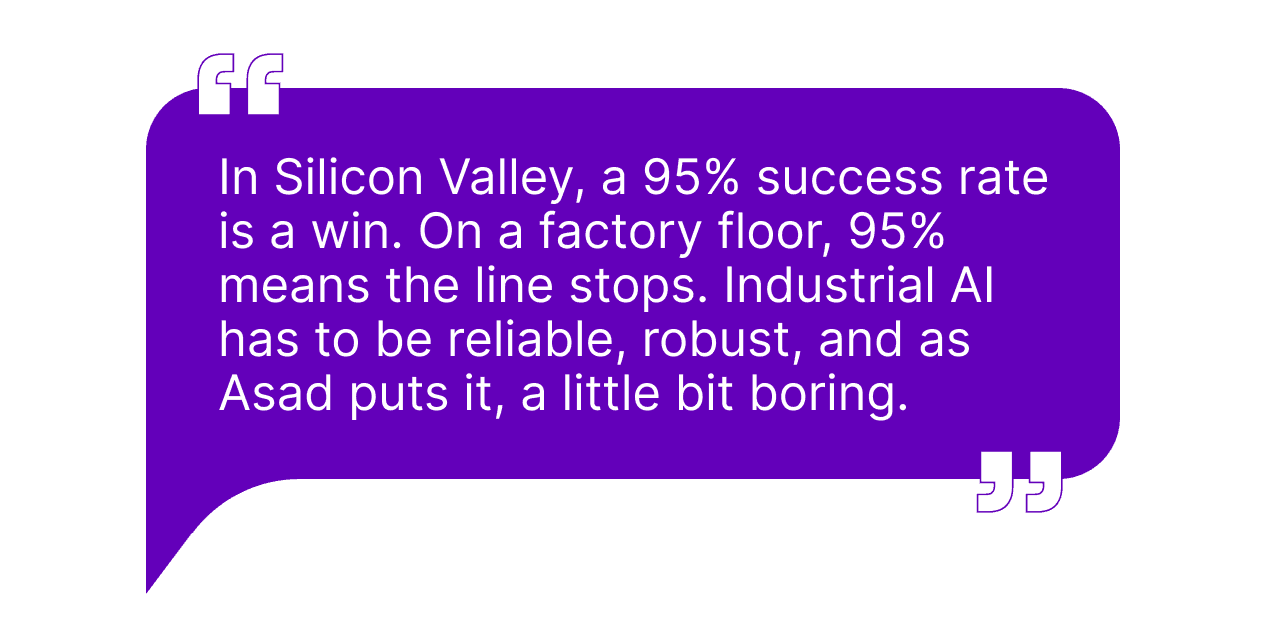
That standard is what separates real production-ready systems from impressive demos.
The Human-Machine Boundary
On the question of autonomy and accountability, Asad is clear. The human sets the intent and the safety limits. The robot handles the variation. The human defines what needs to happen. The robot figures out how to execute it in an unpredictable environment. That boundary is non-negotiable.
The End State
Asad's vision for the model-driven factory is unambiguous. The shift becomes irreversible the moment the unit economics of an adaptive facility outperform the legacy model. The end state is a shop floor where you do not program anything. You show the fleet a new part and the system figures out how to run it. Once a manufacturer can launch a new product line in days instead of months, the old way of building things is no longer viable.
Read the full interview with Jeannie Cahalane at AI Press Room: https://aipressroom.com/asad-tirmizi-trener/