What Is Software-Defined Robotics And How Does It Work Across Robot Brands?
September 24, 2026
,

Production floors can include robots from several brands. A shop might have an ABB cell from a project five years ago, a Universal Robots arm added last year, and a FANUC unit on order for a new line. Each one typically comes with its own programming language, its own teach pendant, and its own way of doing things, which means the same task, picking a part or loading a machine, often gets built three separate times instead of once.
Software-defined robotics is an approach to closing that gap: building the application logic once, in a way that isn't tied to a single robot brand's programming environment, so the same task definition can be reused across supported hardware, with configuration and validation for each cell.
What is software-defined robotics?
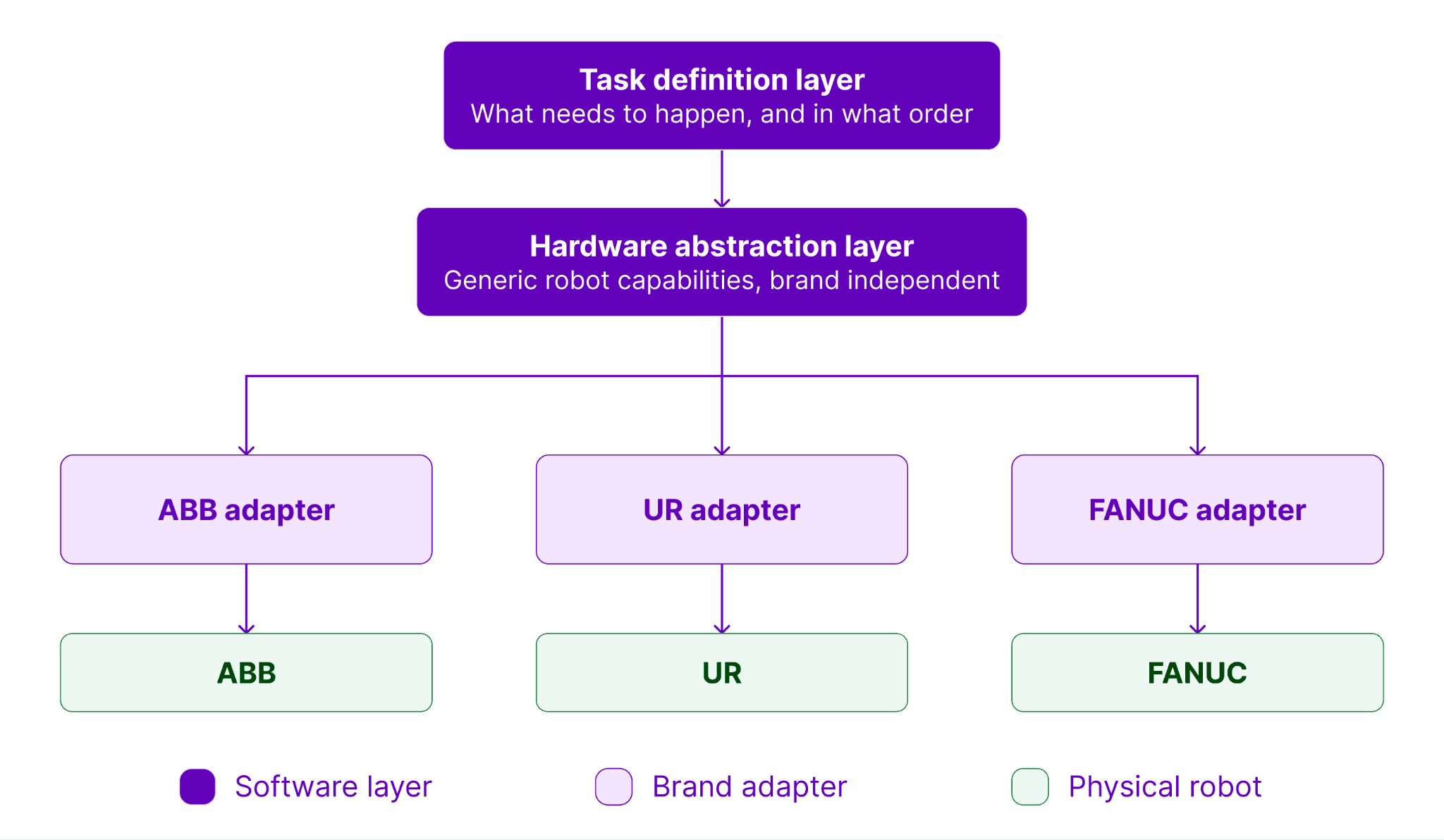
Software-defined robotics separates the logic of a task, what needs to happen, in what order, under what conditions, from the specific robot hardware executing it. Instead of writing a program directly in one brand's proprietary language, the task is defined at a layer above the hardware, and a translation step below it handles what a specific robot brand and controller actually need to carry that out.
This is the architectural foundation behind robot-agnostic robotics software: the goal isn't a single feature, it's a design approach where task logic and hardware execution are kept separate from each other.
How does software-defined robotics work?
Hardware abstraction and robot adapters
The core of the architecture is a hardware abstraction layer, a layer that represents robot capabilities (motion, gripping, I/O) in a generic way, independent of any one brand's command set. Sitting underneath it, brand-specific adapters translate those generic capabilities into the actual commands, motion parameters, and communication protocol a given robot controller expects.
Reusable task and skill definitions
Once hardware differences are abstracted away, a task can be defined once and reused across supported robots, adjusting parameters like part dimensions or target location for jobs within its configured capabilities. From Code to Intelligence explores the shift from code-defined workflows to model-defined robot skills.
Runtime execution and orchestration
At runtime, the system takes a defined task, resolves it through the appropriate brand adapter, and executes it on the physical robot, with planned motions checked against the configured robot and cell constraints, including reach and collision risks, before those motions execute. Real-Time Control covers how execution stays within a deterministic control layer during this process.
Monitoring and production data
Beyond execution, the system tracks what's actually happening: job status, cycle counts, faults, and performance data across cells, giving a shop or an integrator one place to see what's running rather than checking each robot brand's own interface separately.
Why is mixed-brand robot integration difficult?
Proprietary programming languages and tools
Each robot brand generally has its own programming language and development environment. An engineer fluent in one brand's tools often needs meaningfully different training to work confidently in another, which limits who can support a mixed fleet.
Different controller interfaces and communication protocols
Controllers vary in how they expose I/O, handle safety signals, and communicate with other equipment. Integrating a cell with a specific machine interface can mean solving a similar problem more than once, one time per robot brand involved.
Duplicated deployment and maintenance work
When a task needs to run on more than one robot brand, it's often built, tested, and maintained separately for each one. That duplicated effort adds up, particularly for a shop or integrator running the same category of task, like machine tending, across cells from different manufacturers.
How can one software layer support different robot brands?
Common task definitions
A task, like a pick-and-place or a machine tending sequence, is defined once, at the level of what needs to happen rather than how a specific controller executes it.
Brand-specific translation and validation
That common definition is translated into the specific commands each supported robot brand and controller requires, and checked against the robot model's limits and the cell configuration, including reach, payload, tooling, and collision risks, before deployment. Cell-specific risk assessment and safety validation remain part of commissioning.
Standardized deployment workflows
Rather than a distinct deployment process per robot brand, teams can follow one general workflow for configuring and commissioning a cell, adjusted for brand-specific setup steps rather than starting over each time.

Centralized monitoring across cells
Job status, faults, and production data are visible across cells using supported robot brands and controllers.
What is the difference between robot-agnostic and robot-compatible software?
For evaluation purposes, it helps to distinguish architectural independence from verified compatibility.
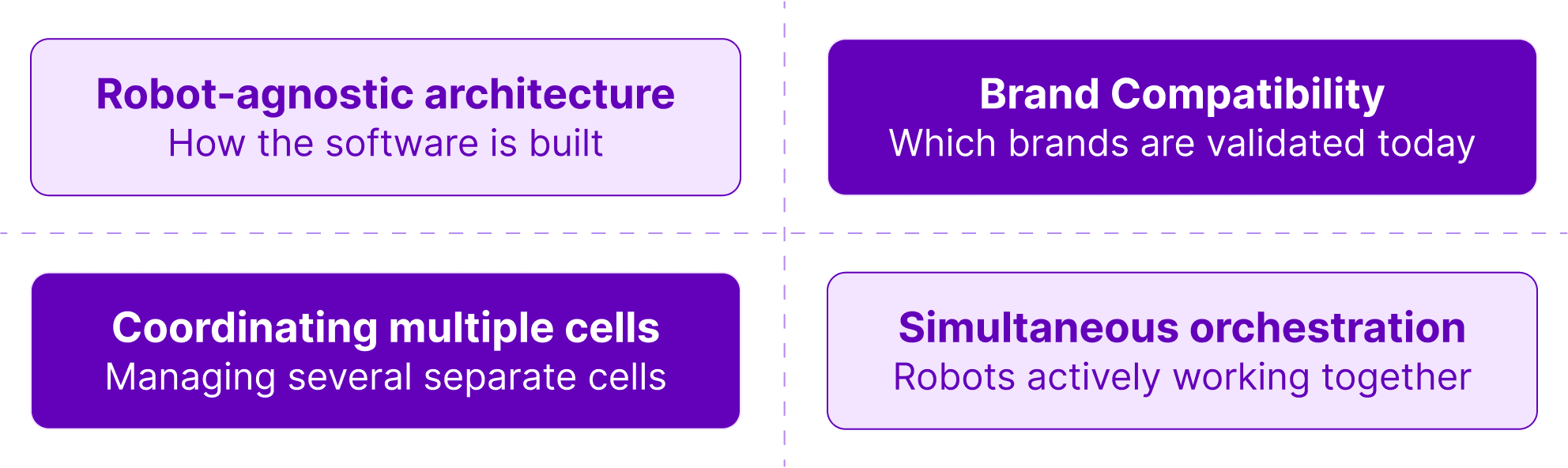
Robot-agnostic architecture describes how the software is built: task logic is separated from any single brand's programming environment, so the underlying design isn't dependent on one manufacturer's tools. This is a statement about architecture, not a claim that every robot brand is currently supported.
Compatibility with named robot brands and controllers is a separate, specific claim: which brands and controller models have actually been validated and are supported today. Acteris currently lists support for ABB, Universal Robots, and FANUC, with further brand support planned. A robot-agnostic architecture makes adding new brand support achievable without rebuilding the whole system, but it doesn't mean every robot on the market is supported right now.
It's also worth separating two more terms that get used loosely: coordinating multiple cells means managing and monitoring several separate robot cells, potentially running different brands, from one system. Simultaneously orchestrating multiple robots is a more specific claim about robots actively working together, in real time, on a shared task or shared workspace. A platform can coordinate multiple cells without necessarily orchestrating simultaneous multi-robot execution, and the two shouldn't be assumed to mean the same thing when evaluating a system.
Who benefits most from software-defined robotics?
Manufacturers operating mixed robot fleets
A shop with robots from more than one brand can standardize how tasks are built and deployed, while reducing duplicated programming work across brands.
High-mix plants with frequent production changes
Shops that change part types often benefit from task definitions that adjust through parameters, since a new part within the task's configured range can be handled by updating inputs across supported robot brands.
Integrators deploying similar applications across customers
An integrator building a similar application, like machine tending, across different customers with different robot brands can reuse the underlying task logic instead of starting from scratch for each project. Our Partners page covers how Trener supports integrators deploying this way.
What should teams verify before adopting a multi-brand robotics platform?
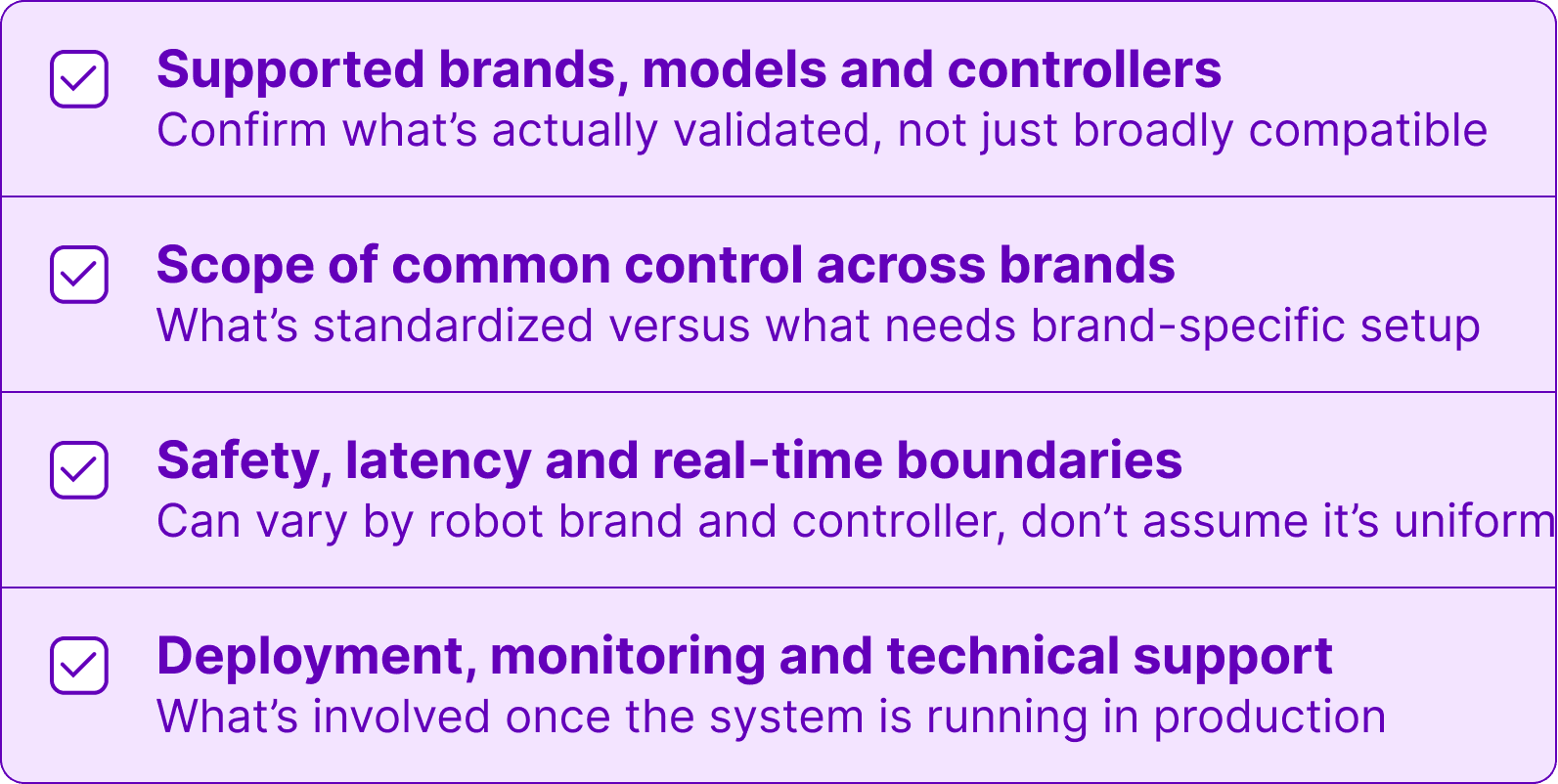
Supported robot brands, models and controllers
Confirm which specific brands, models, and controller versions are actually validated and supported, not just which brands are broadly compatible in principle.
Scope of common control across brands
Ask what's genuinely standardized across brands versus what still requires brand-specific configuration. A platform can be robot-agnostic in architecture while still needing real setup work per brand and per cell.
Safety, latency and real-time boundaries
Confirm how the platform handles safety-rated signals, real-time control requirements, and latency, since these can vary by robot brand and controller, and shouldn't be assumed to work identically across all of them without validation.
Deployment, monitoring and technical support
Understand what deployment actually involves for each robot brand in your fleet, and how monitoring and support work once the system is running in production.
Asking these questions directly, rather than assuming "robot-agnostic" means "works with anything," is the more reliable way to evaluate a platform before committing to it.
How does software-defined robotics support Physical AI?
A hardware abstraction layer can also help apply AI-driven decision-making across a mixed fleet. When task logic isn't tied to one brand's programming environment, AI-driven planning can reuse a common task interface, while execution is configured and validated for each supported robot and cell. Our Applications page covers the specific tasks this supports in production today.
Frequently Asked Questions
What is software-defined robotics?
Software-defined robotics separates a task's logic from the specific robot hardware executing it, allowing task definitions to be reused across supported robot brands through a hardware abstraction layer and brand-specific adapters, with configuration and validation for each cell.
Can one software platform work with different robot brands?
A robot-agnostic architecture is designed to support multiple robot brands, but actual support depends on which brands and controllers have been validated. Acteris currently supports ABB, Universal Robots, and FANUC, with further brand support planned.
What is the difference between robot-agnostic and robot-compatible software?
Robot-agnostic describes the underlying architecture, with task logic kept separate from any one brand's programming environment. Robot-compatible refers to compatibility with particular robots or controllers; teams should confirm which models, versions, and functions have been validated and are supported today. An architecture being robot-agnostic doesn't mean every robot brand is currently supported.
Can software-defined robotics be added to existing robot cells?
It depends on the specific robot brand, controller, and cell setup, and should be evaluated case by case rather than assumed. Our Acteris platform page lists current supported brands; contact us to confirm controller compatibility and deployment requirements for your existing cell.