How to Automate CNC Machine Tending for High-Mix, Low-Volume Production
August 27, 2026
,

CNC machine tending is a common target for automation in machine shops. The robot loads a part, the machine does its work, the robot unloads the finished part, and the cycle repeats. In theory, it is straightforward. In practice, high-mix production adds significant complexity, while much of the available guidance assumes high-volume production with long runs of the same part.
This guide is for shops that run ten different part types in a single shift, change over constantly, and need to assess whether automation is worthwhile. For these shops, automation can be viable when the system is designed for frequent changeovers.
What Is CNC Machine Tending Automation?
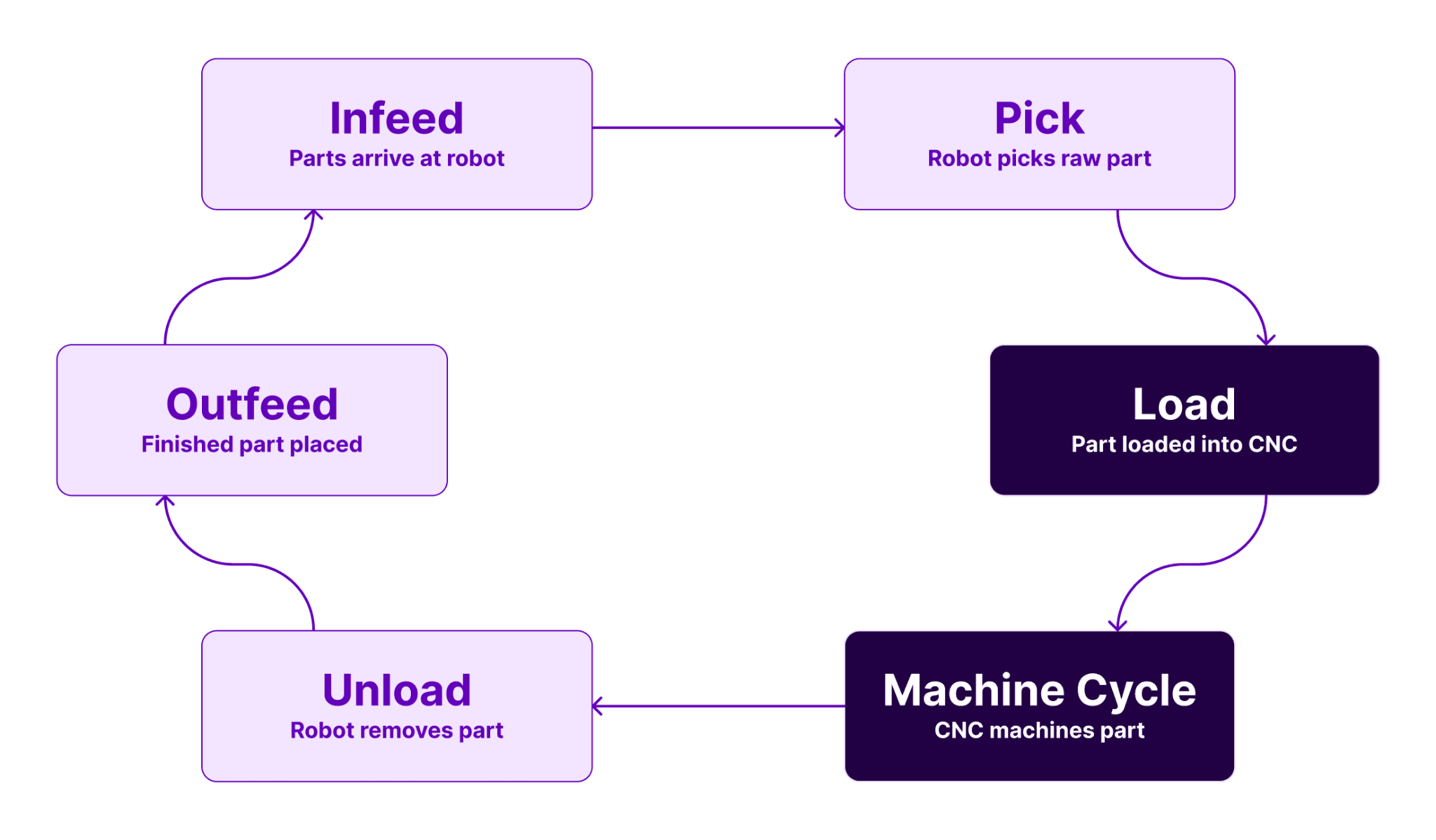
At its core, a machine tending robot performs four tasks: picking a raw part from an infeed, loading it into the machine, waiting for the cycle to complete, and unloading the finished part to an outfeed. Additional steps, such as blow-off, inspection, rinsing, and part orientation, are built around that core loop.
What makes this more complex than it sounds is the communication between the robot and the machine. The robot needs to know when the machine door is open, when the vise is ready, and when the cycle has completed. Without reliable handshaking between the robot controller and the CNC, the cell cannot run unattended. This is a common integration risk and should be evaluated early when scoping a new deployment.
Which CNC Loading and Unloading Tasks Can Robots Automate?
Presenting raw parts to the robot
Raw parts need to arrive at the robot in a location it can reliably reach. This is typically handled by a tray or grid-based infeed system, where parts are placed in fixed, known positions. More advanced setups use vision-guided picking, which can accommodate variation in part position and orientation and is particularly valuable when part types change frequently.
Loading and unloading the CNC machine
The robot picks the raw part, presents it to the machine fixture or vise, and loads it with the precision required for machining. Once the cycle is complete, it removes the finished part and transfers it to the outfeed. The robot also manages the machine door, triggering it to open and close in coordination with its own movements.
Cleaning, inspection, and finished-part outfeed
Many cells include additional steps beyond the basic load-unload cycle. Blow-off routines clear chips and coolant from the part and vise before and after machining. Inspection stations check dimensional or surface requirements at a defined frequency. Finished parts are then placed into an organized outfeed, either a grid tray, a collection bin, or a downstream conveyor, with the robot tracking position and count automatically.
What Makes High-Mix, Low-Volume CNC Tending Difficult?
Frequent part and job changeovers
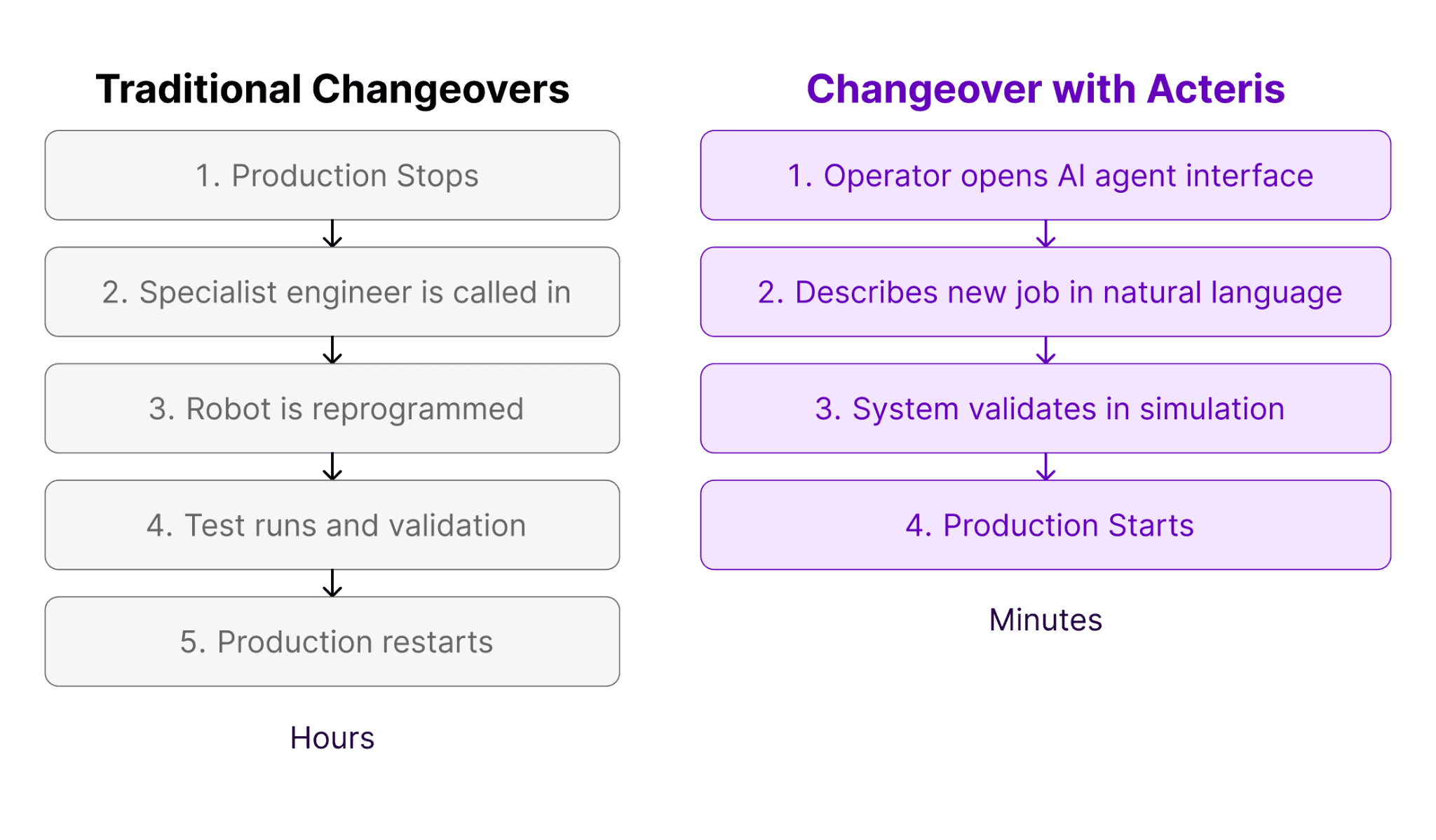
Frequent changeovers are a major source of complexity in high-mix machine tending. Every time you switch to a new part type, several things need to change: the job parameters, the grip position, the fixture or vise setup, and sometimes the infeed configuration. In a traditional tending setup, these changes often require specialist intervention to update the program and reconfigure the cell. The resulting changeover burden can make automation impractical for many high-mix shops.
Variation in part presentation
Even within a single job, parts do not always arrive in exactly the same position or orientation. Slight variation in how parts are loaded into the infeed tray, or natural settling during a run, can cause a traditional tending system to miss or mishandle a pick. Systems without vision or adaptive capabilities typically depend on tightly controlled part presentation to run reliably.
Robot-to-CNC communication
The robot and the CNC machine need to communicate reliably throughout every cycle. Door signals, vise clamp and unclamp confirmation, and cycle start handshaking all need to be correctly implemented for the cell to run unattended. Missing or unreliable I/O signals can stop the cell or prevent it from running unattended.
Recovery from interruptions
Even well-configured cells encounter unexpected situations: a part that did not pick cleanly, an infeed that ran empty, a machine alarm. In a traditional setup, these events stop the cell until an operator intervenes. Systems with more capable event handling can detect the issue, respond appropriately, and either recover autonomously or alert the operator with enough context to resolve it quickly.
Which CNC Machines and Parts Are Suitable for Robotic Tending?
Mills, lathes, and machining centers
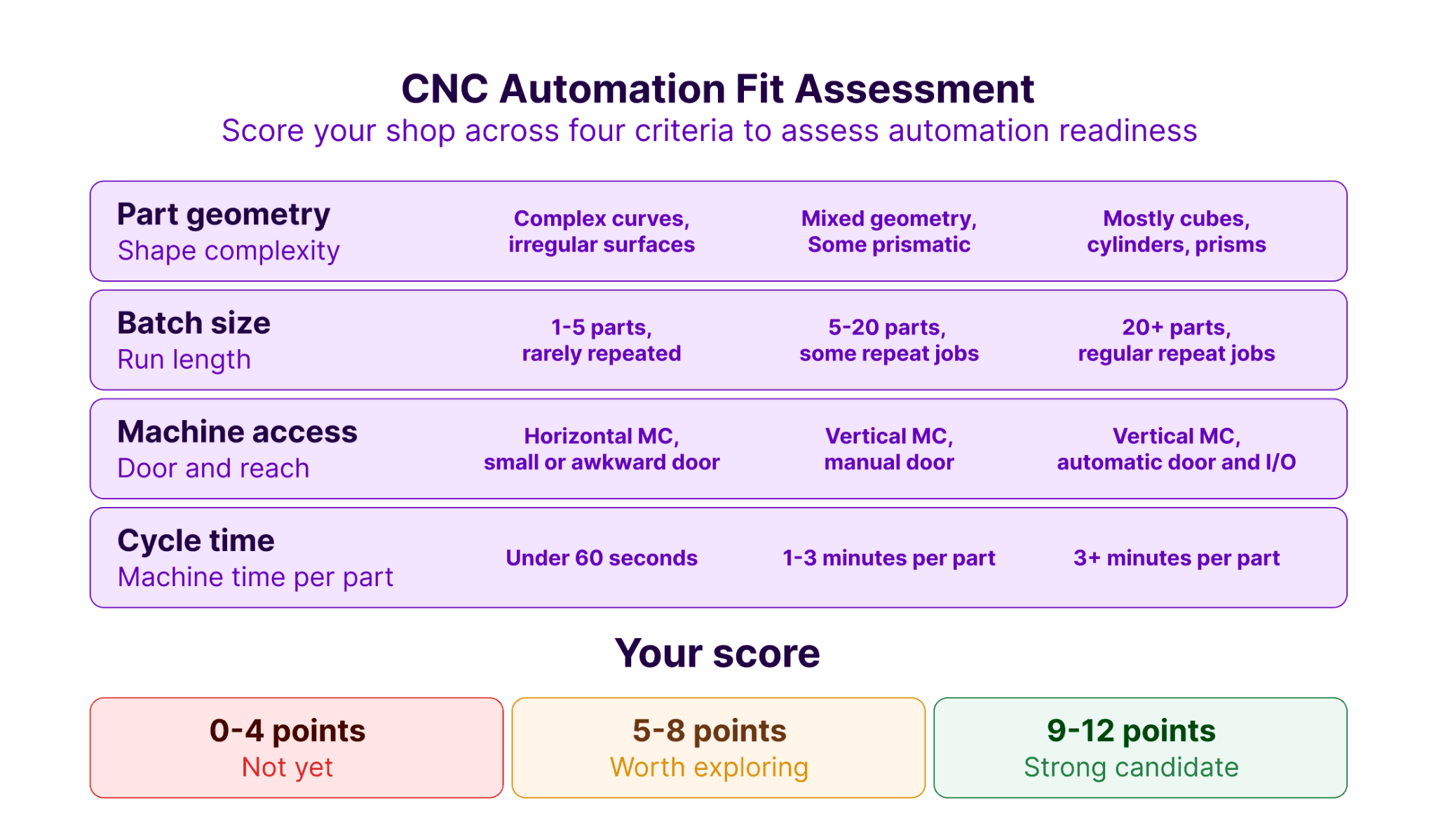
Vertical machining centers with automatic doors and standard I/O interfaces are generally the easiest starting point. Machines that already have door interlock signals and vise control outputs require less integration work. Horizontal machining centers are generally harder to automate due to door placement and working envelope constraints. Lathes with bar feeders or chuck-loading requirements add complexity but are well-established applications with proven integration patterns.
Part size, weight, and geometry
Regular prismatic or cylindrical parts are generally easier to handle than complex, curved, or delicate components. If your parts are consistent enough in shape that a gripper can reliably pick them, you are in good shape. If every part is completely different, you will need a more capable vision and gripping system. Part weight affects gripper and robot selection, and surface sensitivity affects how the part can be contacted and handled.
Cycle time and repeat frequency
Machine cycle time should be assessed together with robot loading and unloading time. With very short machining cycles, robot handling can account for a large share of the total cell cycle and may constrain throughput. With longer machining cycles, the robot has more idle time and may be able to tend additional machines. Repeat frequency also matters: jobs that run regularly are easier to justify than jobs that appear once a month.
What Does an Automated CNC Machine Tending Cell Need?
Robot and end-of-arm tooling
The robot arm needs sufficient reach, payload, and repeatability for the parts and machine in question. The gripper needs to handle the range of part geometries you plan to run. Parallel finger grippers work well for prismatic parts. More complex geometries may require custom tooling or adaptive grippers. A blow-off nozzle integrated into the gripper is common for clearing chips before unloading.
Part infeed and outfeed
Parts need to arrive at the robot in a predictable location. The simplest approach is a tray or grid system like the EasyRobotics ProFeeder, where parts are placed in fixed positions. More advanced setups use vision-guided picking, which removes the need for precise placement and is particularly valuable in high-mix environments.
CNC interface and machine access
The robot needs to communicate with the machine via digital I/O or a standard protocol. At minimum, this covers door open and close signals, vise clamp and unclamp, and cycle start. More advanced setups include spindle status and error detection. This is worth confirming with your machine tool vendor before scoping a project.
Safety system
Collaborative robots may be able to operate without full guarding in some configurations, but cobot status does not automatically determine the required safeguarding. A formal risk assessment is required for every deployment regardless of robot type. The safety design needs to be part of the cell specification from the start, not an afterthought.
Job setup and production monitoring
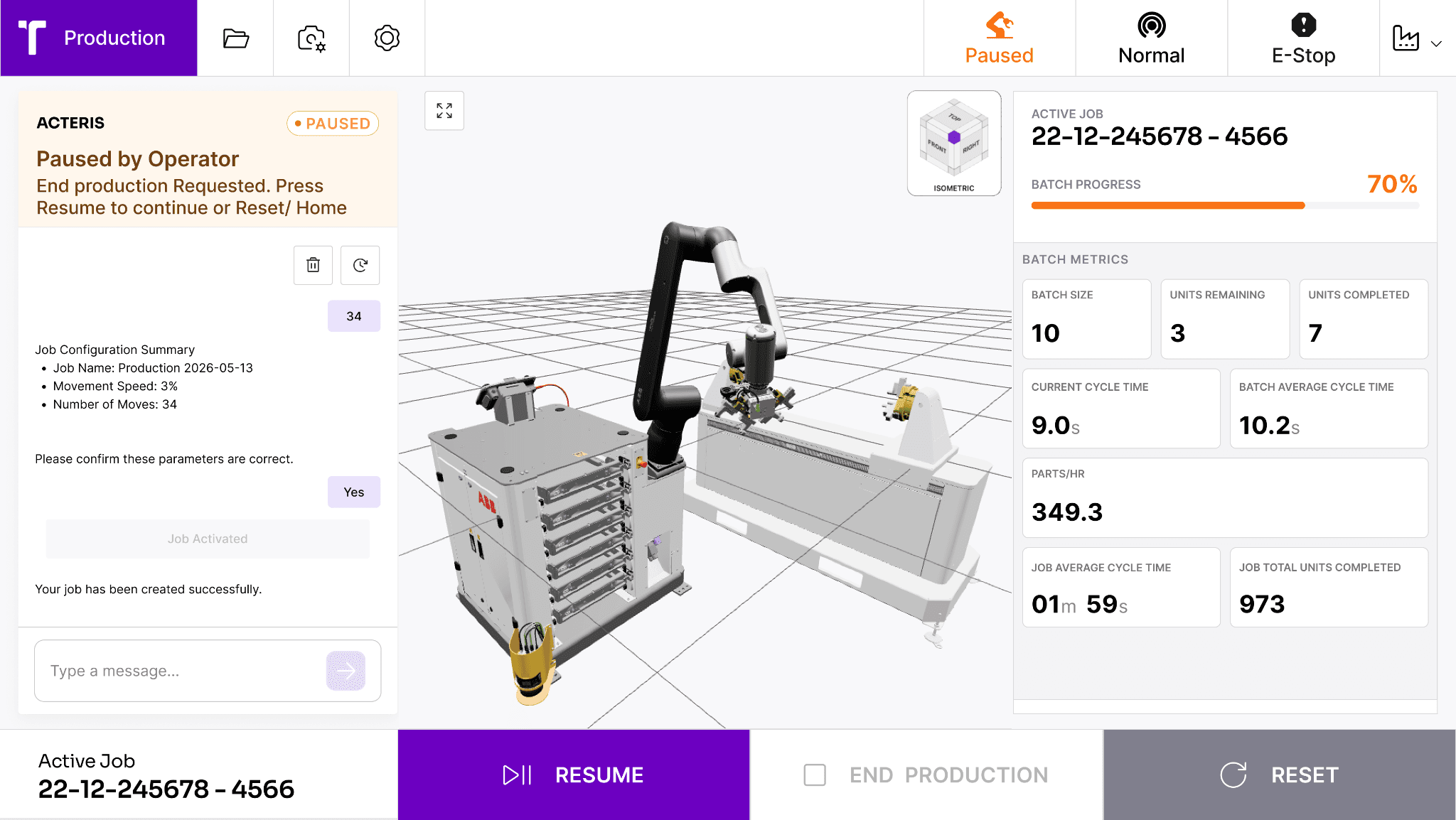
Operators need a way to configure new jobs and monitor production without relying on specialist programming knowledge. In an Acteris-based cell, job setup happens through the AI agent interface, and production metrics including cycle time, batch progress, parts per hour, and robot utilization are visible on the dashboard in real time.
When Is CNC Machine Tending Suitable for Small-Batch Production?
High-mix, small-batch production is difficult for traditional automation because frequent changeovers can erode the time and cost savings automation is intended to deliver. The economics of machine tending automation depend on both production volume and changeover cost. Lower changeover costs allow more small-batch jobs to justify automation.
In a traditional tending setup, changeover cost is dominated by reprogramming time. For example, if switching to a new part type takes four hours of specialist time, a batch of twenty parts may not justify the changeover cost. Reducing changeover to minutes can materially improve the calculation.
For a high-mix shop, the practical test is whether the changeover process can be made fast enough for automation to be worthwhile across the jobs it actually runs.
How Can AI Support CNC Tending With Frequent Changeovers?
Parameterized job setup
With Acteris, an operator describes the new job through the AI agent interface in natural language, specifying part dimensions, batch size, and process requirements. The system validates the configuration in simulation and deploys it to the robot, significantly reducing the programming effort required. Changeovers that traditionally required hours of specialist reprogramming can often be completed in minutes, as demonstrated in the Fluidotronica deployment below.
Part localization under variable presentation
Rather than requiring parts to be placed in precise, pre-programmed positions, Acteris uses AI-powered vision to locate parts in the infeed and compute the pick position in real time. This can reduce the need for a dedicated fixture plate for each supported part type, lowering changeover overhead in high-mix tending setups. For a deeper look at how this works, read our article on CAD-less vision.
Runtime monitoring and recovery
Once production is running, Acteris monitors the cell continuously. Safety events, production stops, and infeed and outfeed status are surfaced in real time. When the system encounters an unexpected scenario, it can either adapt within defined parameters or ask the operator how to proceed through the AI agent interface, rather than stopping the line and waiting for an engineer.
The Fluidotronica Deployment
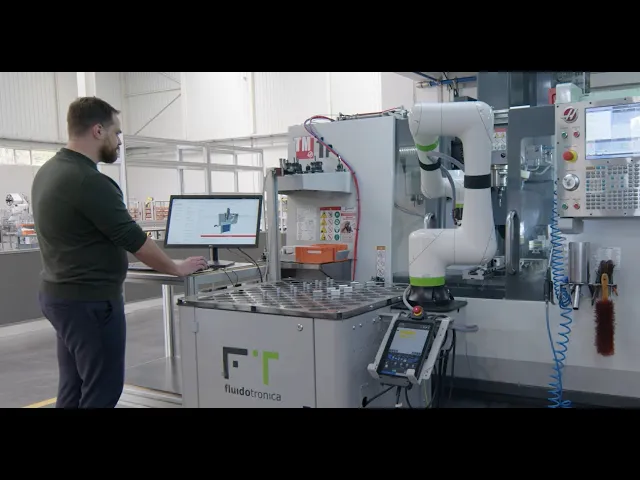
Fluidotronica, our integration partner in Portugal, deployed Acteris on a FANUC CRX-10iA collaborative robot paired with a Haas TM-1P 3-axis milling machine. The cell handles cylindrical and cuboid blanks of varying sizes, picked from an EasyRobotics ProFeeder tray, loaded into the automated vise, machined, inspected, rinsed where required, and placed back onto the grid or into a collection bin, all without manual intervention.
Operators configure each production run through the Acteris AI agent, specifying batch size, part geometry, blow-off routines, inspection frequency, and outfeed handling. The system adapts the full workflow to the production run at hand rather than executing a fixed program.
Metrics Worth Tracking
Before committing to a machine tending project, establish a baseline for the operating metrics that matter most. Once Acteris is running, its production dashboard provides real-time visibility into key cell and job metrics, reducing the need to compile them manually.
Cycle time: Current cycle time and batch average cycle time, so you can see immediately whether the cell is running to expectation and where variation is creeping in.
Batch progress: Units completed, units remaining, and batch size tracked in real time, so operators always know where a production run stands without having to check with anyone.
Parts per hour: Your throughput rate, updated continuously throughout the run.
Job average cycle time: A running average across the full job, useful for comparing performance between part types and identifying which jobs run most efficiently.
Job total units completed: A cumulative count across the life of a job, useful for understanding overall output and tracking against targets.
Uptime and robot utilization: Uptime measures the share of scheduled time the cell is available for production, while robot utilization measures the share of time the robot is actively working. Tracking them separately helps distinguish cell downtime from unused robot capacity.
Measuring these metrics before automation provides a baseline for comparison. Once the cell is running, use the metrics available in the Acteris dashboard to compare actual performance with that baseline.
How Should a Machine Shop Plan Its First CNC Tending Project?
Select a stable pilot process
A strong first machine tending project combines a reasonable batch size, consistent part geometry, a machine with good door and interface access, and a cycle time that creates a useful unattended operating window without making robot handling the bottleneck. Start there, prove the model, and expand from there.
Measure the current manual workflowBefore scoping automation, document the current machine cycle time, operator touch time per part, and changeover time. These figures provide a baseline for comparison and help your integration partner scope the right solution.
Define changeover and recovery requirements
Be specific about what changeover must look like for automation to be viable. Document the number of part types the cell must handle, the target changeover time, and the required response to unexpected scenarios, such as stopping for operator intervention or issuing an alert. Defining these requirements upfront avoids costly redesigns later.
Involve operators and an integration partner
The operators who will use the cell every day have invaluable knowledge about edge cases, part variability, and machine behavior that does not show up in any specification document. Involve them early. At the same time, a qualified integration partner can help you evaluate your floor, identify the best candidate process, and navigate the machine interface and safety requirements that are easy to underestimate from the outside. For more on how to build the business case for a project like this, read our articles on the Business Case for Automation in CNC Machine Shops and What If Automation Actually Worked for Small CNC Shops.
Before You Request a Quote
A pre-deployment assessment will go faster and produce more accurate recommendations if you have already gathered the following information about your target cell:
Part weight, material, geometry, and surface sensitivity
Typical batch size and number of weekly changeovers
CNC make and model, door automation type, vise interface, and I/O availability
Current machine cycle time and operator touch time per cycle
Chip and coolant management requirements, inspection steps, and downstream handling needs
Desired unattended operating window
This information helps integration partners scope the right cell configuration and identify any interface or handling challenges before the project begins.
Frequently Asked Questions
What is CNC machine tending automation?
CNC machine tending automation uses a robot to load raw parts into a CNC machine, initiate the machining cycle, and unload finished parts to an outfeed, allowing the machine to run unattended between operator interventions. The robot communicates with the machine via digital signals to coordinate door operation, vise control, and cycle start.
Can a robot load and unload an existing CNC machine?
Many existing CNC machines can be retrofitted for robotic tending if the robot can interface with the door and workholding controls and reach the fixture within the available working envelope. Vertical machining centers are generally easier to automate than horizontal machining centers. A pre-deployment assessment can confirm compatibility.
Is robotic machine tending suitable for small batches?
Yes, particularly when the changeover process is fast. AI-powered systems like Acteris allow operators to configure new jobs in minutes through a conversational interface, which significantly reduces the overhead of switching between part types. The economics improve with longer runs, but high-mix shops with short batches can still benefit if changeover time is minimized.
Which CNC machines are easiest to automate?
Vertical machining centers with automatic doors and standard I/O interfaces are generally the easiest starting point. Machines that already have door interlock signals and vise control outputs require less integration work. Lathes with bar feeders or chuck-loading requirements add complexity but are well-established applications. A strong candidate combines repeat demand, consistent part geometry, an accessible working envelope, and a cycle time that the robot can support without constraining throughput.