What Is Physical AI in Manufacturing?
August 20, 2026
Vincent Chavy
,
VP of Marketing

For decades, industrial automation has followed the same basic logic: define a task precisely, program a robot to execute it exactly, and keep everything as consistent as possible so the robot never has to think. That logic worked well in high-volume, low-mix environments, but as production variability increases, its limitations become more apparent.
Much of manufacturing does not look like a high-volume assembly line. It looks like a machine shop running dozens of different part types in a single shift, or a production line adapting to new suppliers, new SKUs, and shifting priorities without stopping to reprogram. What these environments share is not low volume: it is high variability. The cost of that variability often shows up in familiar ways. Changeovers that eat half a shift. Fixtures machined for a part that has already come off the schedule. A CNC cell sitting idle while someone tracks down the one engineer who can edit the program.
Physical AI is the technology category built for that reality.
What Is Physical AI?
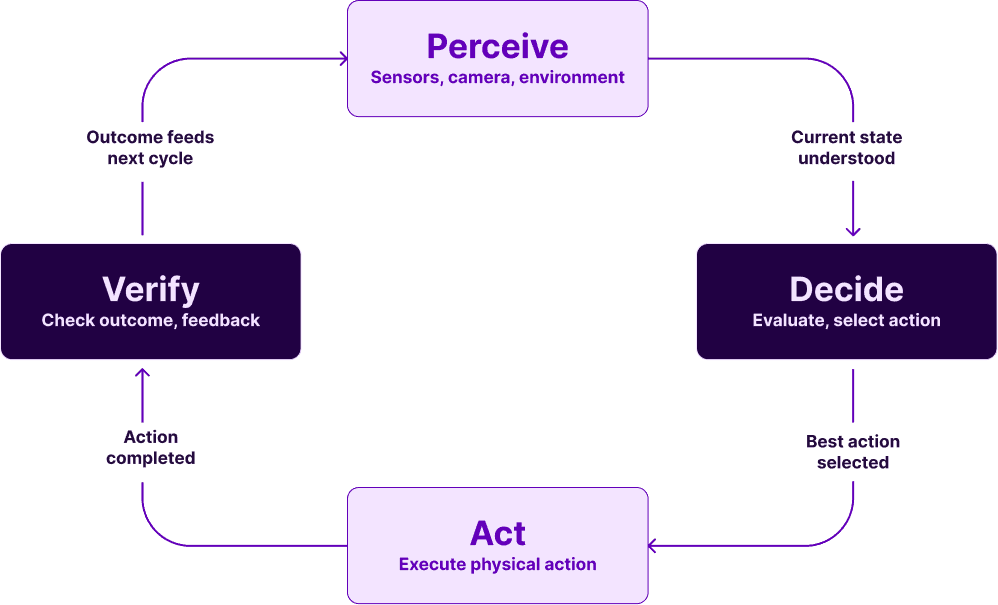
Physical AI refers to artificial intelligence systems that can perceive their physical environment, make decisions based on what they observe, and take physical actions in the real world, all within a continuous feedback loop. The cycle has four stages:
Perceive. Sensors and cameras build a real-time understanding of the cell: where the part is, how it is oriented, what has changed since the last cycle.
Decide. Based on what it perceives, the system determines the appropriate action rather than following a fixed script.
Act. The system executes the physical action: it picks the part, loads the chuck, and closes the door.
Verify. The system checks whether the action achieved the intended outcome and feeds that information back into the next cycle. For example, the system can detect that a part has shifted in the gripper before loading it into the machine.
It is worth clarifying how Physical AI relates to two other terms. Embodied AI is a subset of Physical AI, referring specifically to systems that learn and adapt through direct physical interaction with their environment. Physical AI is the broader term, covering any AI system that perceives, reasons, and acts in the real world, including industrial applications that go beyond robotics alone. Industrial AI is a separate term that can include data analysis, process optimization, and robotic control.
Industrial AI can identify that a machine is about to fail. Physical AI connects that intelligence to physical action, enabling a robot to respond.
How Is Physical AI Different From Traditional Robot Automation?
Traditional robots typically execute a fixed sequence of movements defined in advance by a specialist engineer. They remain reliable while conditions stay within the parameters anticipated by the program. When conditions fall outside those parameters, production may stop or require operator intervention.
Physical AI systems handle variability differently, and the difference is the loop above. Because the system perceives the cell before it acts and verifies the result afterward, the part does not have to arrive in the same place every time. The program is not describing a world. It is reading one.
In a CNC machine tending application using Acteris, an operator can describe a new production job in natural language through the AI agent interface. The system configures the workflow, validates it in simulation, and executes it on the physical robot. When the system encounters a scenario outside its confidence threshold, it can adapt within defined parameters or ask the operator how to proceed, rather than stopping the line and waiting for an engineer.
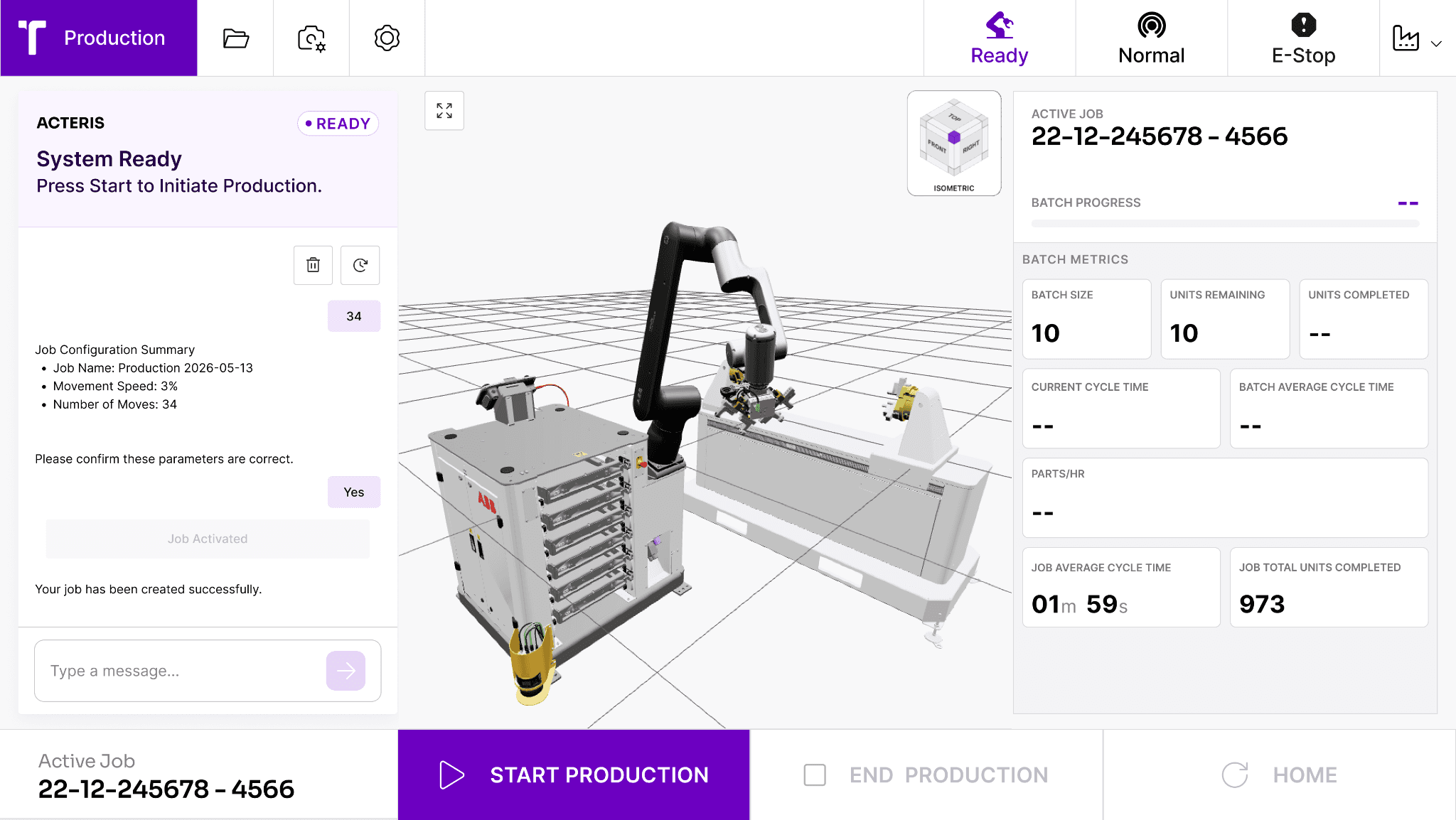
The shift is from automation that requires the world to conform to the program to automation that can adapt to the world as it actually is. A precision machining company in Norway saw this firsthand: a $125,000 robot had been sitting idle because reprogramming it for each new part was too time-consuming. After deploying Acteris, the company could create new production jobs in under two minutes and run the robot unattended between changeovers.
Which Manufacturing Tasks Can Use Physical AI?
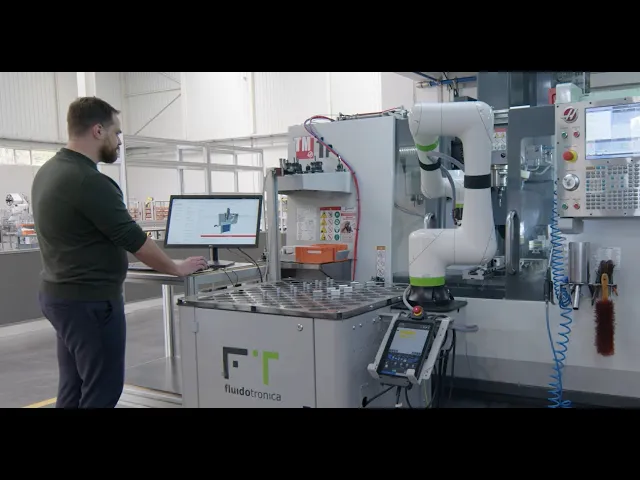
Physical AI delivers the most value where variability is high and traditional automation has historically struggled. In applications such as machine tending, vision-guided part picking, material handling, and assembly, production teams can lose time to reprogramming, rigid fixturing, and dependence on specialists. In supported Acteris applications, operators can create new production jobs in minutes through a conversational interface. AI-powered vision enables robots to locate and handle parts without requiring every position to be programmed in advance, while the system adapts to variability in real time. The video below shows this in practice at Fluidotronica, a partner in Portugal.
Current systems are most reliable in structured environments where the range of variability is understood and bounded. The value is in dramatically expanding the range of tasks that can be reliably automated, not in automating everything.
When Physical AI Is a Good Fit, and When It Is Not
Physical AI performs best when the task has structure, even if the details vary. Repeated operations with bounded variation, frequent changeovers between known part types, and existing manual loading or picking workflows are all strong candidates. If operators are currently doing a task by hand because traditional automation was too rigid or too expensive to justify, that is often a signal that Physical AI is worth evaluating.
It is not the right fit for every situation. Processes that are not yet well defined, environments with uncontrolled or unpredictable inputs, and safety-critical actions that have not been validated through proper controls are not good starting points. Very low repeatability tasks, where no two jobs share meaningful structure, are also better addressed through other means first.
This distinction matters because the value of Physical AI comes from applying intelligence to structured variability, not from automating chaos. The honest starting point is understanding which parts of your operation fit that description.
Does Physical AI Make Industrial Robots Fully Autonomous?
The level of autonomy Physical AI enables depends on the application and the environment. In many scenarios, Acteris handles the full production cycle without human intervention. In others, where conditions are less predictable or the cost of an error getting through is higher, the system is designed to keep operators informed and in control.
This is a deliberate design choice, not a limitation. In industrial production, predictability and safety are non-negotiable, and the right level of autonomy varies by application. The trajectory is toward greater autonomy over time as systems learn from more deployments and trust is established through demonstrated reliability. What Physical AI gives manufacturers today is the flexibility to set that level themselves, with the intelligence to back it up.
How Acteris Applies Physical AI in Manufacturing
Acteris is Trener's AI-native robot application platform, built to apply Physical AI to real industrial environments across CNC machine tending, vision-guided part picking, and other high-mix manufacturing applications. Operators describe what they need in natural language, and the platform configures and executes the automation workflow. Acteris combines real-time motion planning, AI-powered vision, and production monitoring in a single platform compatible with ABB, Universal Robots, and FANUC robots. The platform can be deployed on new cells or retrofitted into existing installations.
For a deeper look at how real-time control enables operating autonomy, read Real-Time Control: The Engine Behind Operating Autonomy. For a closer look at vision-guided part detection without CAD models, read Why Your Robot Should Not Need to Know What a Part Looks Like Before It Picks It Up.
The Research Behind Physical AI at Trener
The capabilities in Acteris are built on a foundation of active research at T-Labs, Trener's dedicated R&D engine. T-Labs advances the core intelligence behind Acteris through the development and validation of pre-trained AI skills across vision, language, haptics, and motion. Capabilities that begin as research prototypes are validated in controlled environments, refined through real deployment data, and released into Acteris as production-ready skills.
Frequently Asked Questions
What is Physical AI in manufacturing?
Physical AI refers to AI systems that perceive their physical environment, decide on an action, act on it, and verify the result in a continuous feedback loop. In manufacturing, it enables robots to handle variability and adapt to changing production conditions without being reprogrammed for every new task.
How is Physical AI different from traditional robot automation?
Traditional robot automation typically executes pre-programmed movements and may stop when conditions fall outside defined parameters. Physical AI perceives the cell in real time and can adjust to changes such as a part arriving in a new position, reducing the need for a specialist to rewrite the program.
When is Physical AI not the right fit?
Processes that are not yet well defined, environments with uncontrolled inputs, and safety-critical actions without validated controls are poor starting points. So are very low repeatability tasks, where no two jobs share meaningful structure. Physical AI applies intelligence to structured variability, not to chaos.
Which manufacturing tasks can use Physical AI?
Common applications include machine tending, vision-guided part picking, material handling, and assembly. The pattern to look for is bounded variability: tasks with repeatable structure but changing details, where traditional automation has been too rigid or too expensive to justify.
Does Physical AI make industrial robots fully autonomous?
Not universally, and that is deliberate. In many applications, Acteris runs the full production cycle without human intervention. Where conditions are less predictable or errors are costlier, it keeps operators in control and asks how to proceed. Manufacturers set the level of autonomy that fits their operation.